
Publications
Books
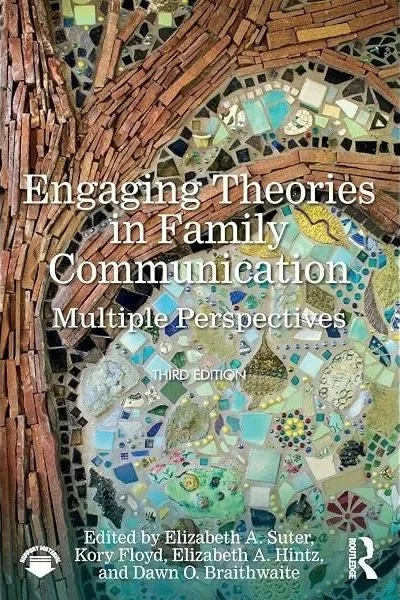
Suter, E. A., Floyd, K., Hintz, E. A., & Braithwaite, D. O. (Eds.). (2027). Engaging theories in family communication: Multiple perspectives. (3rd ed.). Routledge. https://doi.org/10.4324/9781003614173
Journal Articles
Online Ahead of Print
Hintz, E. A., Tucker, R. V., Denes, A., & Gunning, J. N. (2026). Assessing the role of ambivalent sexism on the associations between individual characteristics and sexual well-being in new romantic relationships. Sexuality & Culture. Advance online publication. https://doi.org/10.1007/s12119-025-10523-0
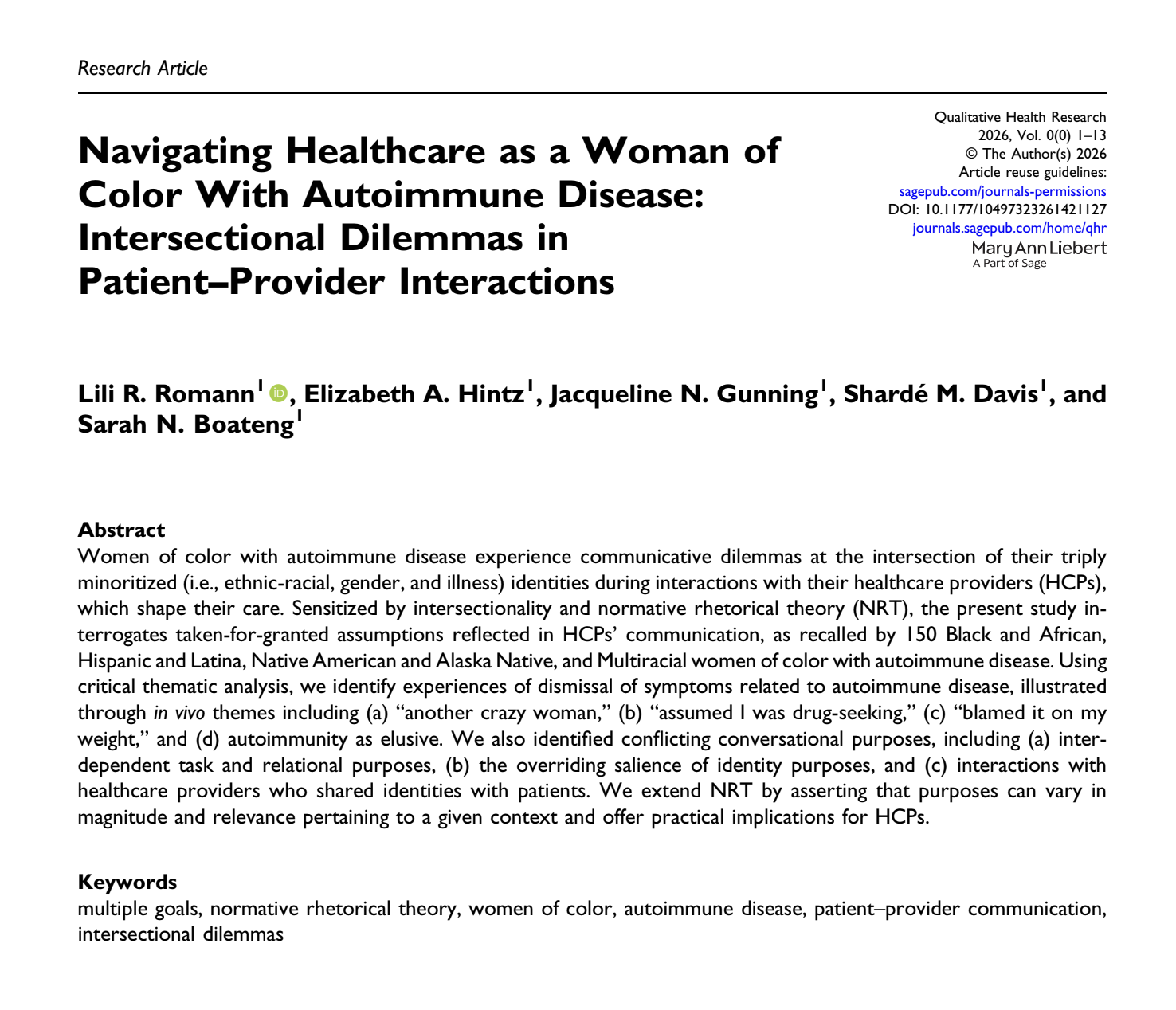
Romann, L. R., Gunning, J. N., *Boateng, S. N., Davis, S. M., & Hintz, E. A. (2026). Navigating healthcare as a woman of color with autoimmune disease: Intersectional dilemmas in patient-provider interactions. Qualitative Health Research. Advance online publication. https://doi.org/10.1177/10497323261421127
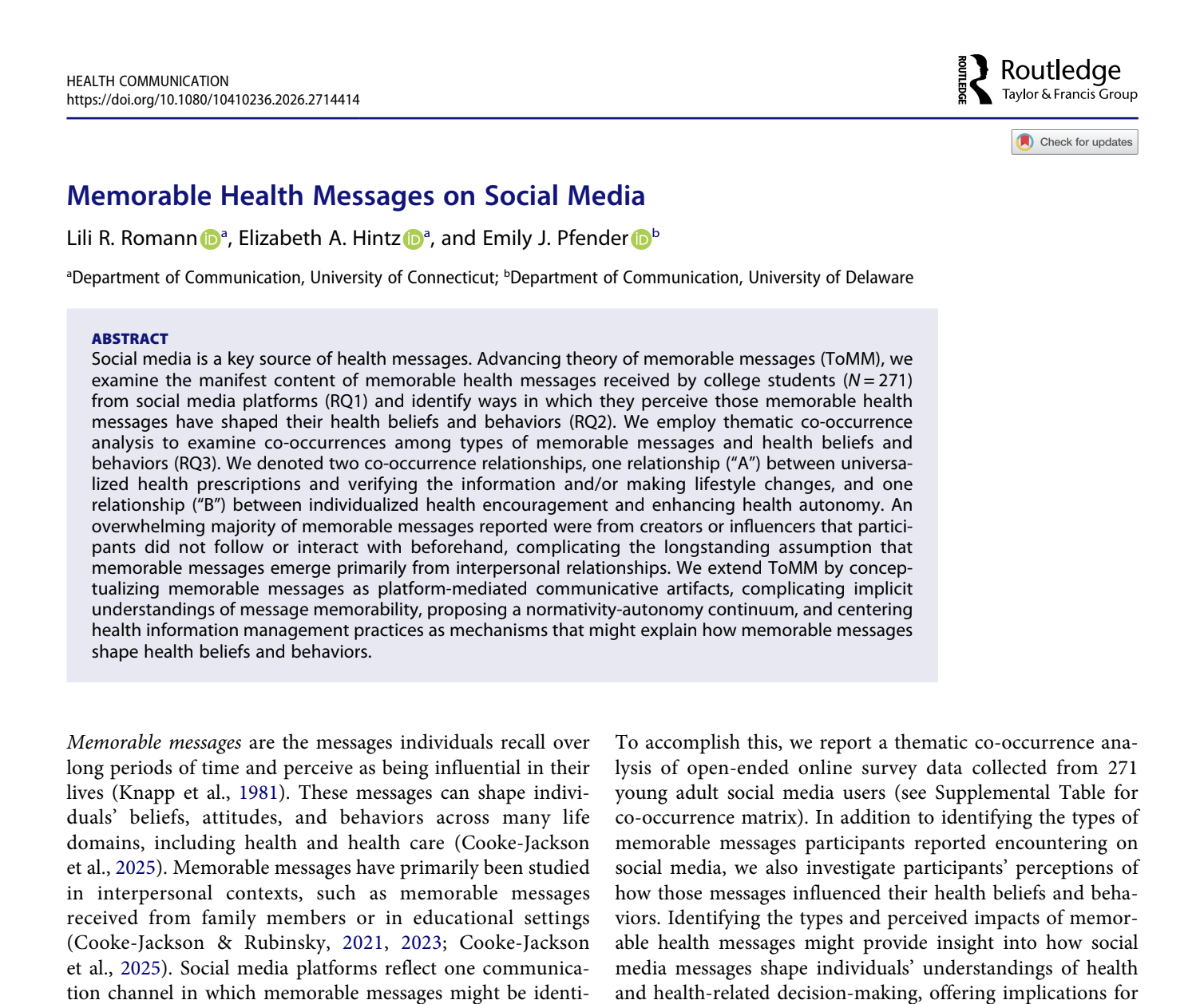
*Romann, L. R., Hintz, E. A., & Pfender, E. J. (2026). Memorable health messages on social media. Health Communication. Advance online publication. https://doi.org/10.1080/10410236.2026.2714414
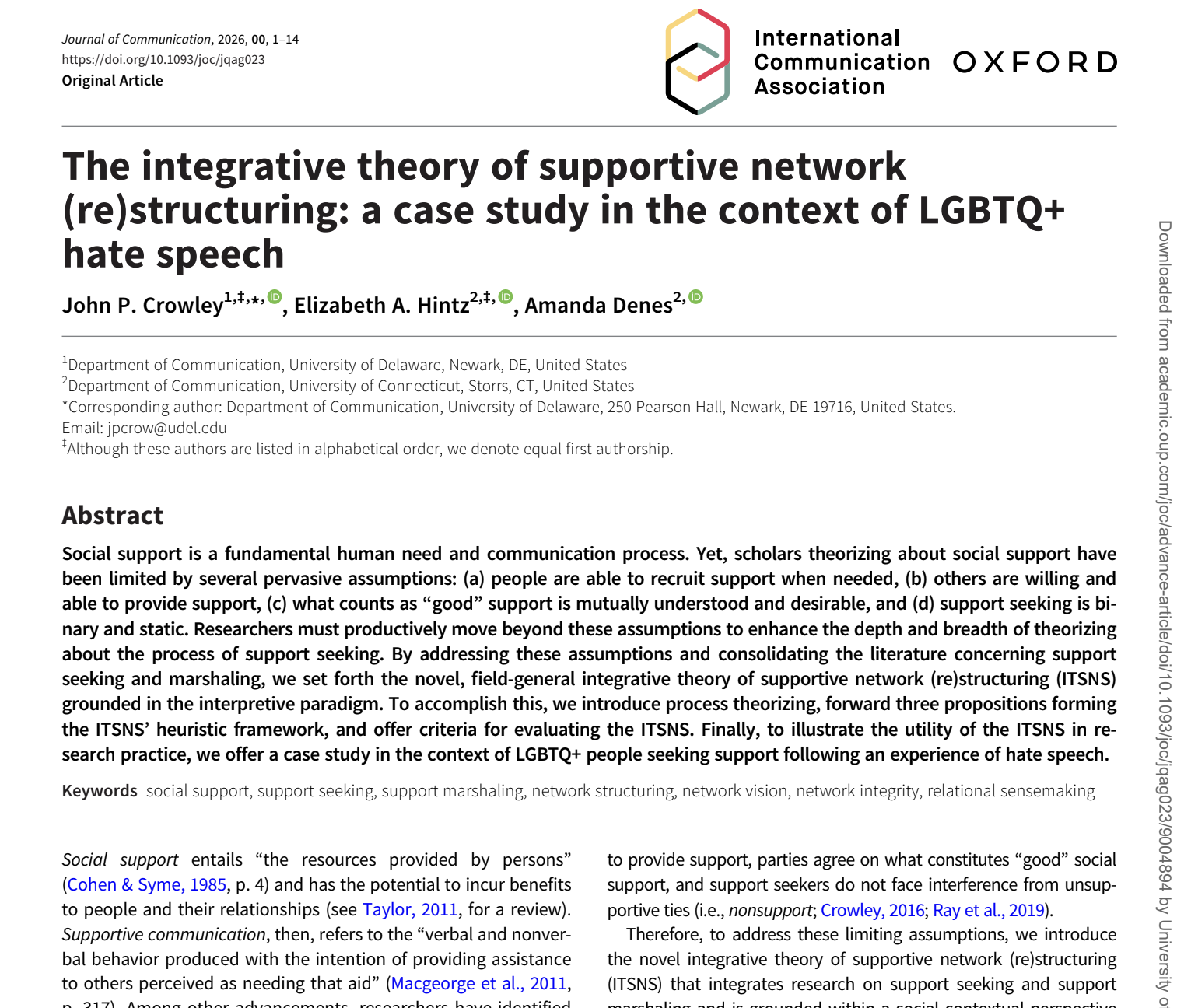
+Crowley, J. P., +Hintz, E. A., & Denes, A. (2026). The integrative theory of supportive network (re)structuring: A case study in the context of LGBTQ+ hate speech. Journal of Communication. Advance online publication. https://doi.org/10.1093/joc/jqag023
+Authors contributed equally to this manuscript and are denoted as equal first authors.
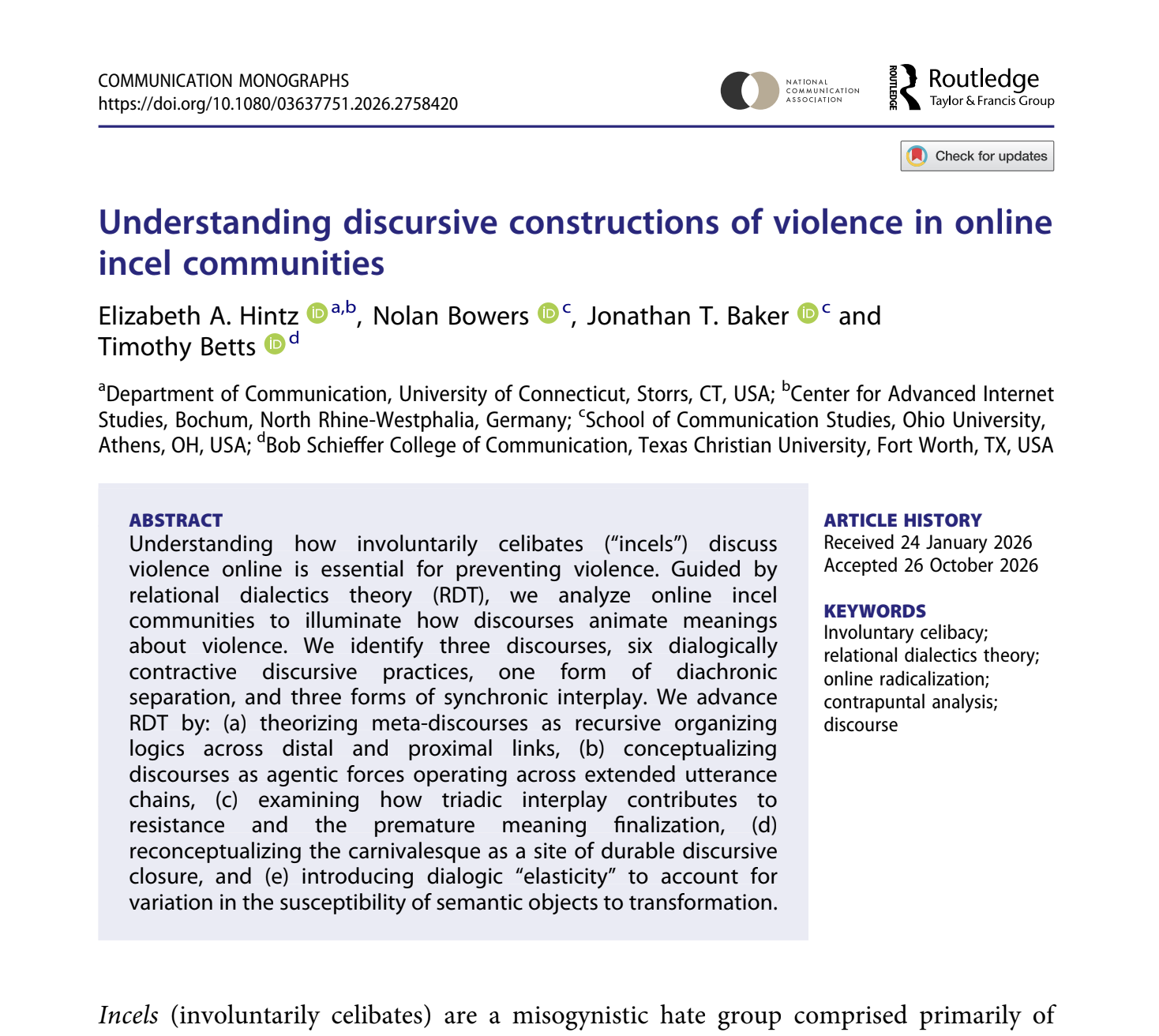
Hintz, E. A., *Bowers, N., Baker, J. T., & Betts, T. (2026). Understanding discursive constructions of violence in online incel communities. Communication Monographs. Advance online publication. https://doi.org/10.1080/03637751.2026.2758420
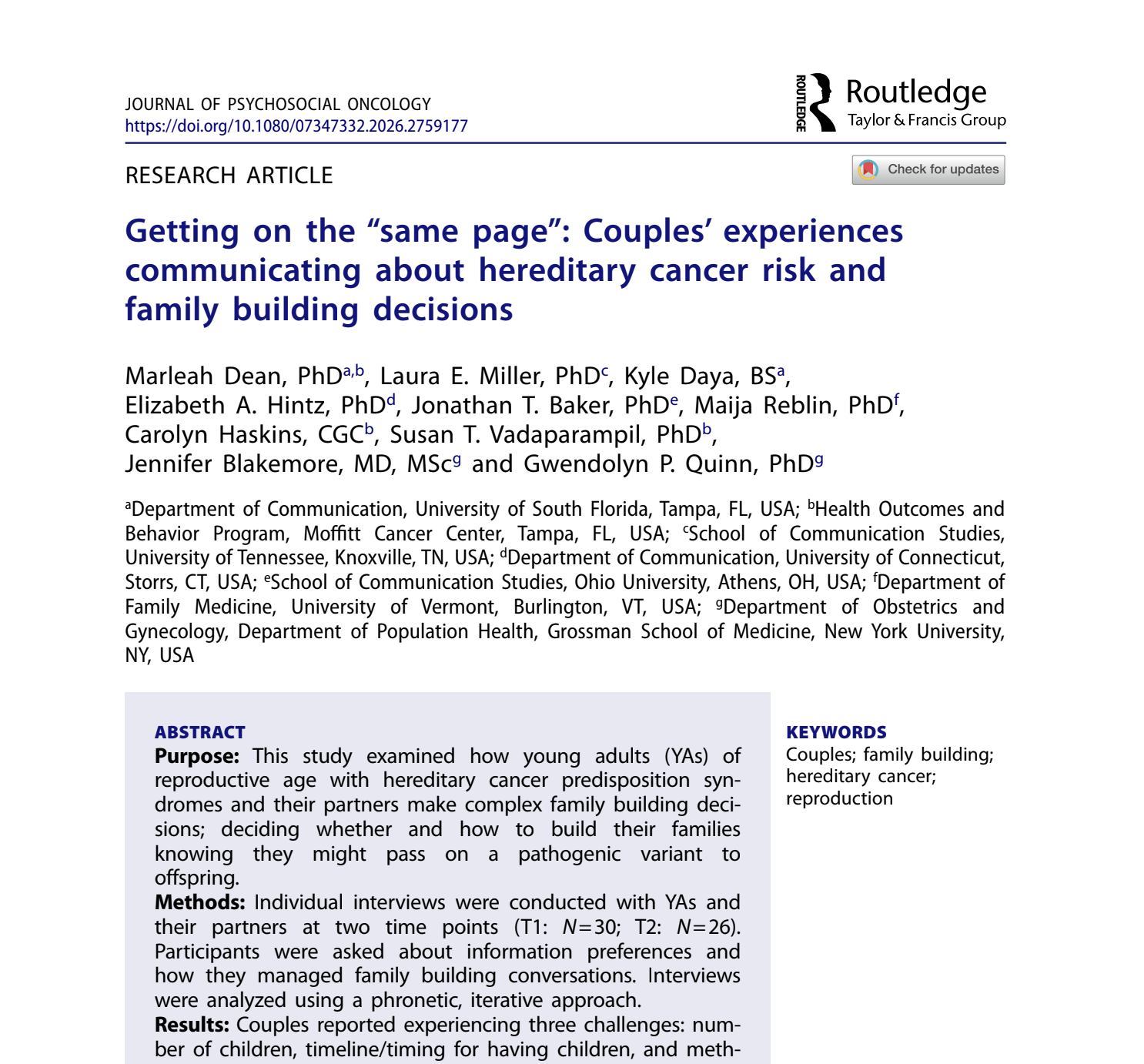
Dean, M., Miller, L. E., Daya, K., Hintz, E. A., Baker, J. T., Reblin, M., Haskins, C., Vadaparampil, S. T., Blakemore, J., & Quinn, G. P. (2026). Getting on the “same page”: Couples’ experiences communicating about hereditary cancer and family building decisions. Journal of Psychosocial Oncology. Advance online publication. https://doi.org/10.1080/07347332.2026.2759177
2026
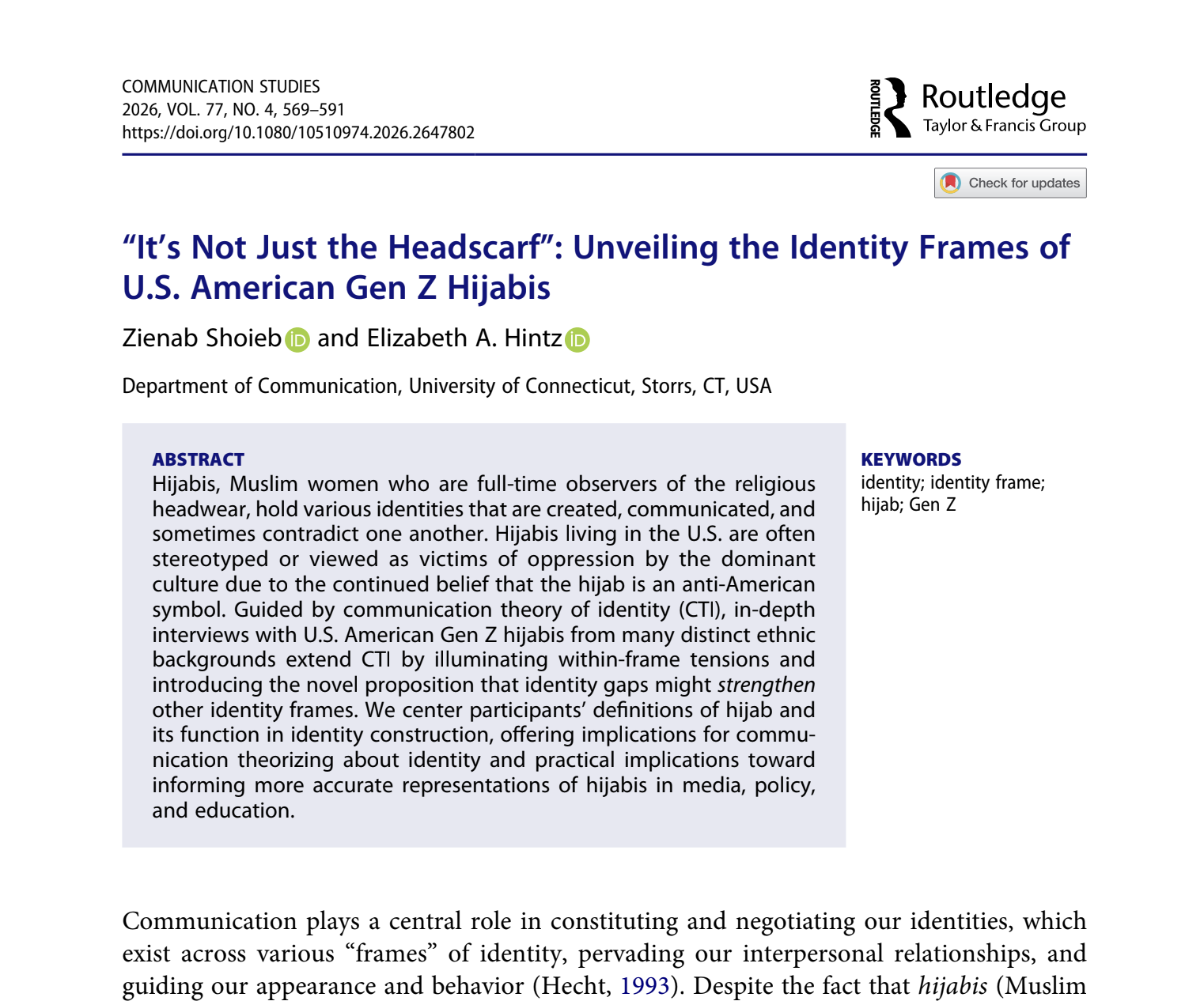
*Shoieb, Z., & Hintz, E. A. (2026). “It’s not just the headscarf”: Unveiling the identity frames of American Gen Z hijabis. Communication Studies, 77(4), 569–591. https://doi.org/10.1080/10510974.2026.2647802
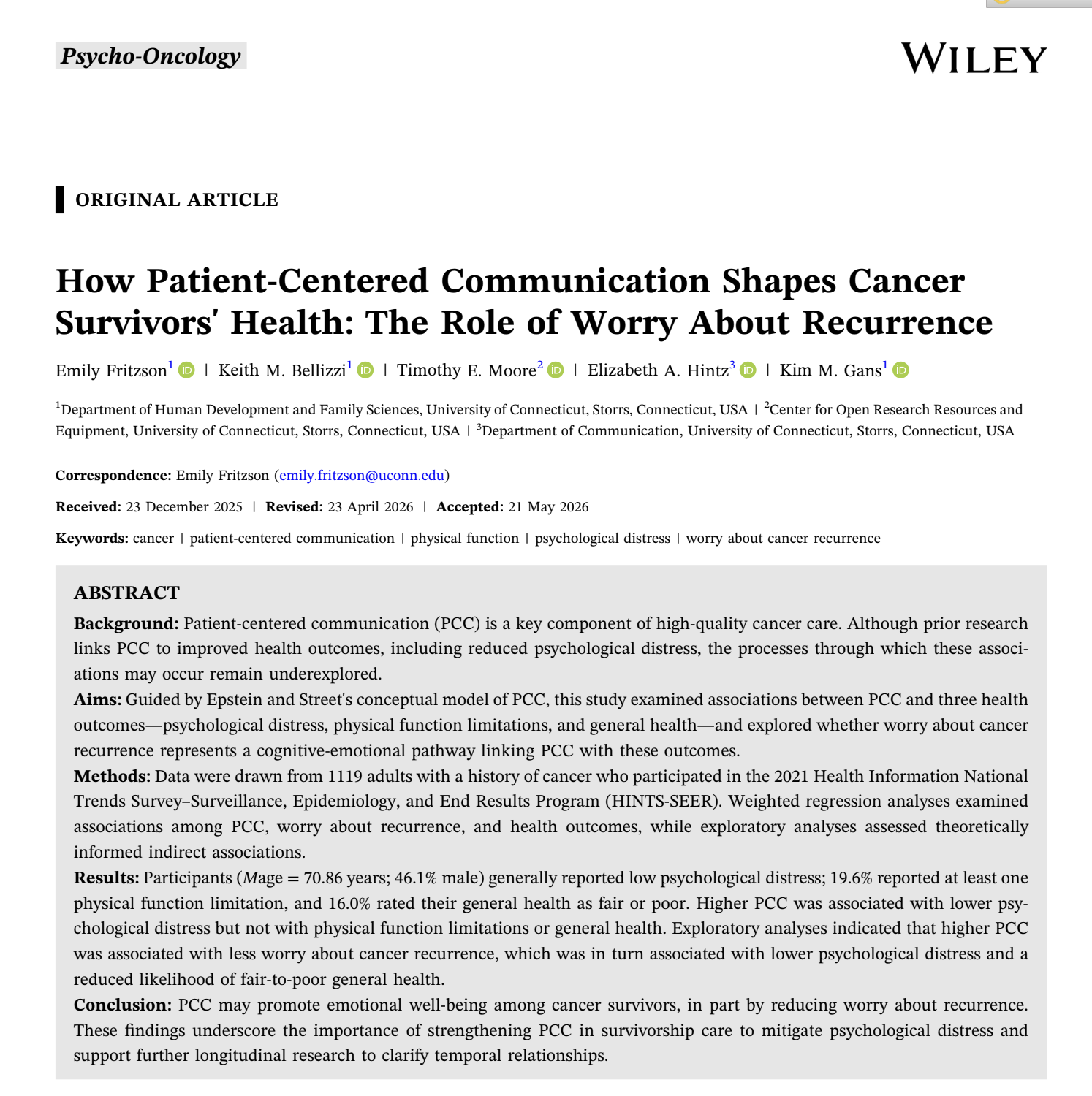
*Fritzon, E., Bellizzi, K. M., Moore, T. E., Hintz, E. A., & Gans K. M. (2026). How patient‐centered communication shapes cancer survivors' health: The role of worry about recurrence. Psycho-Oncology, 35(5), e70498. https://doi.org/10.1002/pon.70498
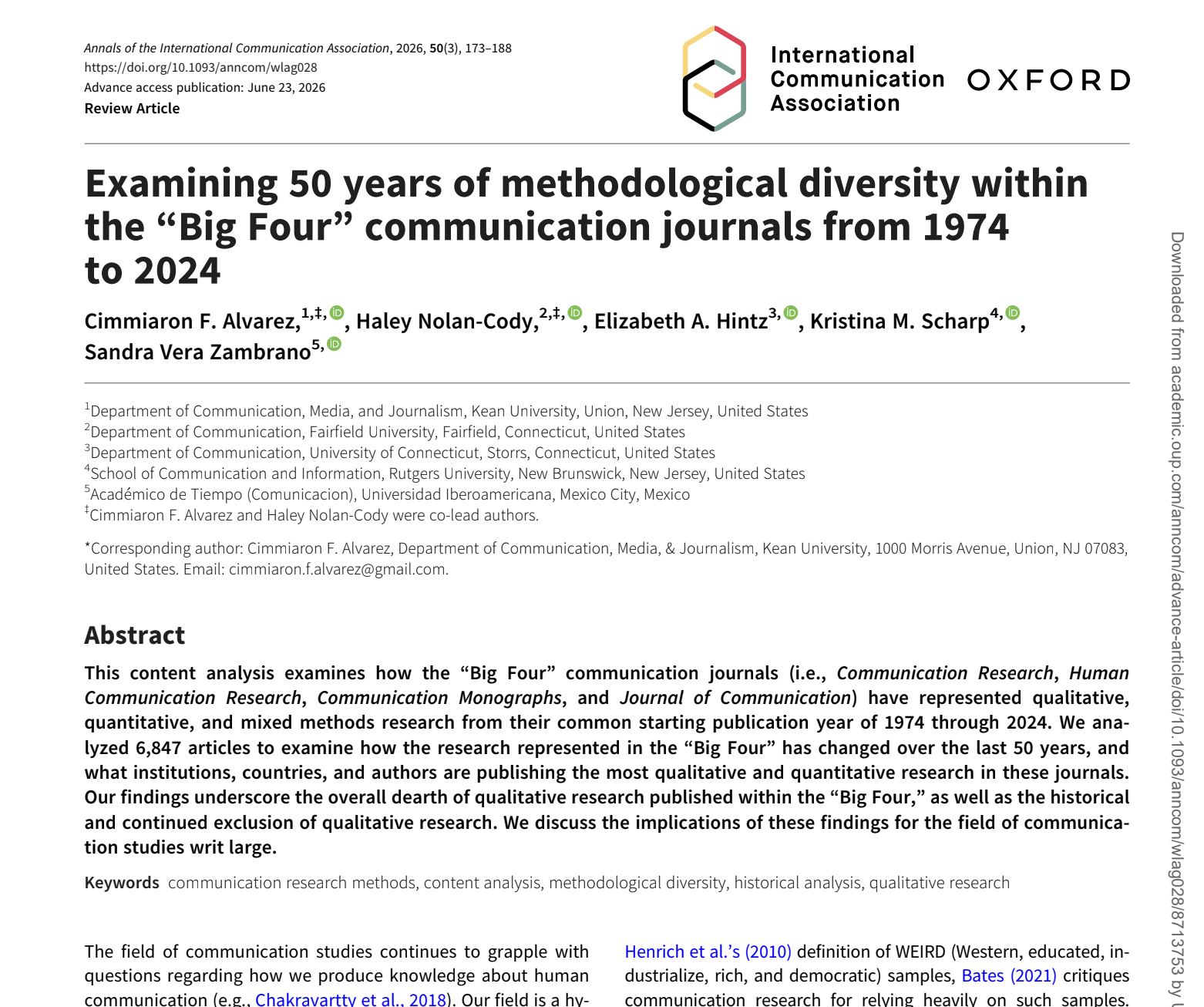
Alvarez, C. F., Nolan-Cody, H., Hintz, E. A., Scharp, K. M., & Vera Zambrano, S. (2026). Examining fifty years of methodological diversity within the “Big Four” communication journals from 1974 to 2024. Annals of the International Communication Association, 50(3), 173–188. https://doi.org/10.1093/anncom/wlag028
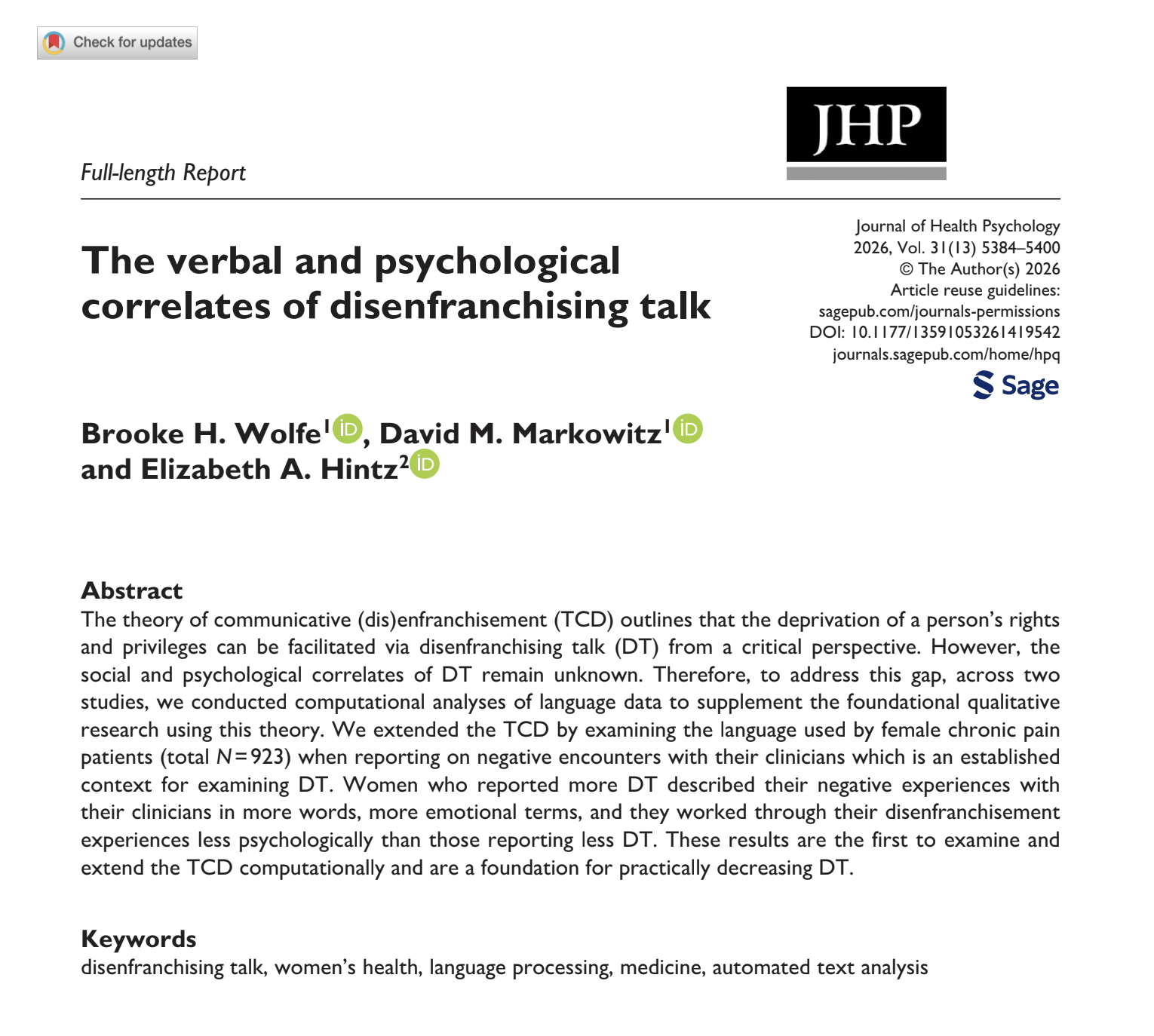
Wolfe, B. H., Markowitz, D. M., & Hintz, E. A. (2026). The verbal and psychological correlates of disenfranchising talk. Journal of Health Psychology, 31(13), 5384–5400. https://doi.org/10.1177/13591053261419542
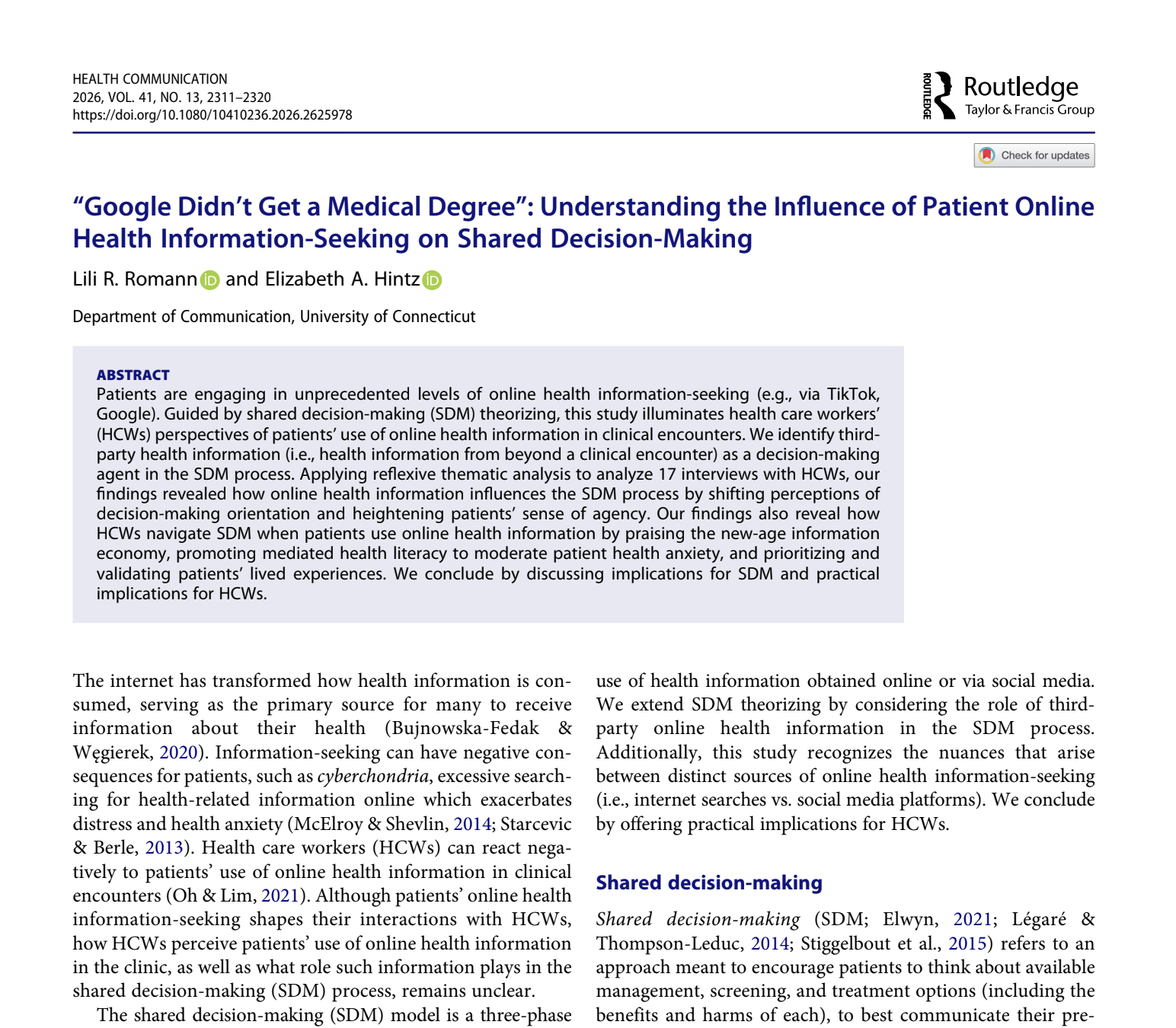
*Romann, L. R. & Hintz, E. A. (2026). “Google didn’t get a medical degree”: Understanding the influence of patient online health information-seeking on shared decision-making. Health Communication, 41(13), 2311–2320. https://doi.org/10.1080/10410236.2026.2625978
2025
Hintz, E. A. & Applequist, J. (2025). "Saving us to death”: Ideology and communicative (dis)enfranchisement in misapplications of the 2016 CDC opioid prescribing guidelines. Health Communication, 40(4), 702–712. https://doi.org/10.1080/10410236.2024.2363674
Wolfe, B. H., *Watson, O. & Hintz, E. A. (2025). Anticipating and experiencing disenfranchising talk: The experiences of patients with Type 1 Diabetes. Social Science & Medicine, 377, 118099. https://doi.org/10.1016/j.socscimed.2025.118099
Gunning, J. N., Denes, A., Hintz, E. A., & Tucker, R. V. (2025). Exploring the associations among implicit sexual beliefs, sexual communal strength, and relational thriving in new romantic relationships navigating sexual dysfunction. Journal of Social and Personal Relationships, 48(8), 2099–2120. https://doi.org/10.1177/02654075251334264
Giglio Ayers, P., Jones, J., Hintz, E. A., Luciano, D., & Ulrich, A. (2025). An uphill battle: Challenges faced by the breastfeeding and pumping gynecologic surgeon. Obstetrics and Gynecology, 145(5S), 7S–8S. http://dx.doi.org/10.1097/AOG.0000000000005851.09
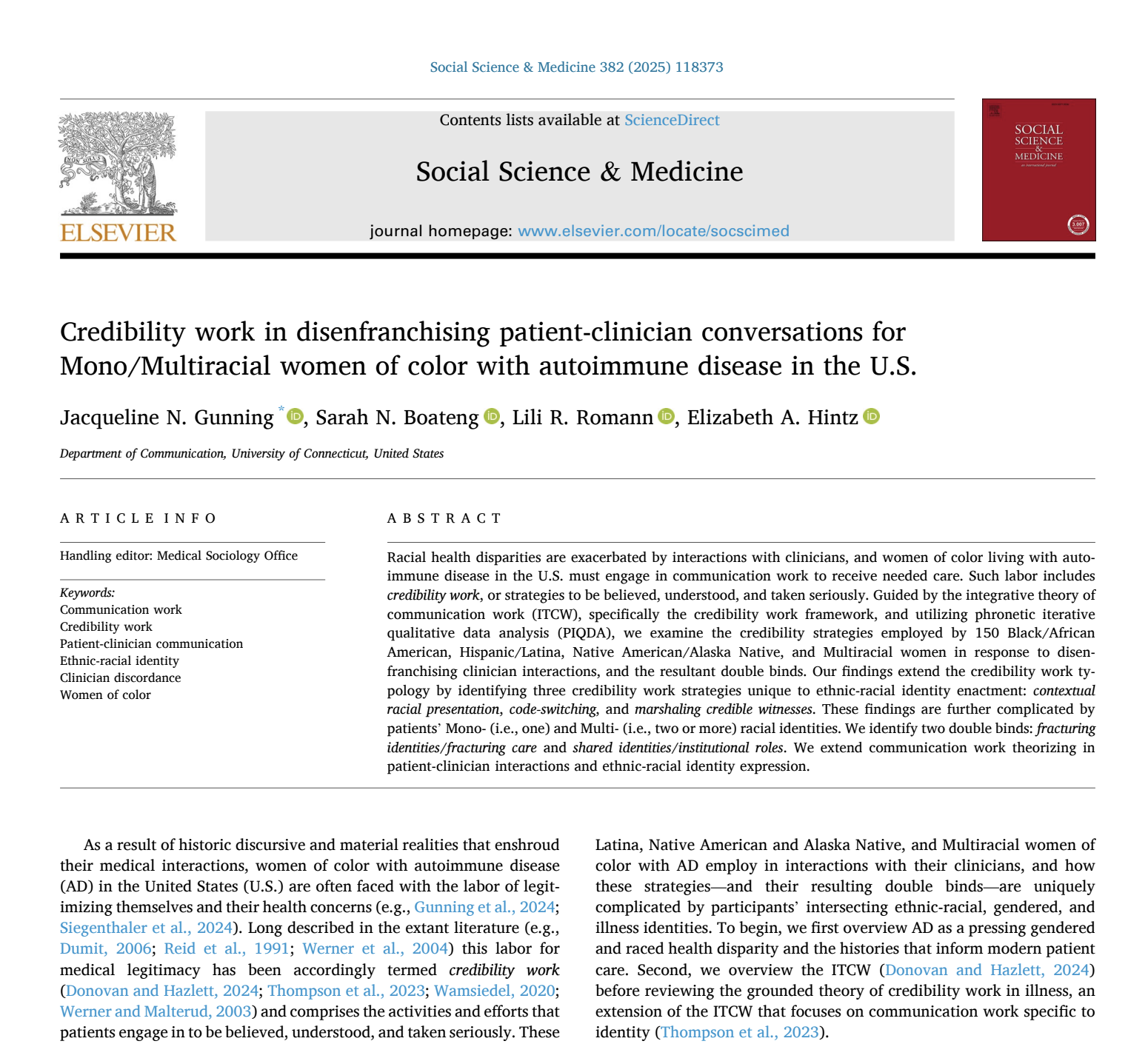
Gunning, J. N., Boateng, S. N., *Romann, L. R., & Hintz, E. A. (2025). Credibility work in disenfranchising patient-clinician conversations for mono/multiracial women of color with autoimmune disease in the U.S. Social Science & Medicine, 382, 118373. https://doi.org/10.1016/j.socscimed.2025.118373
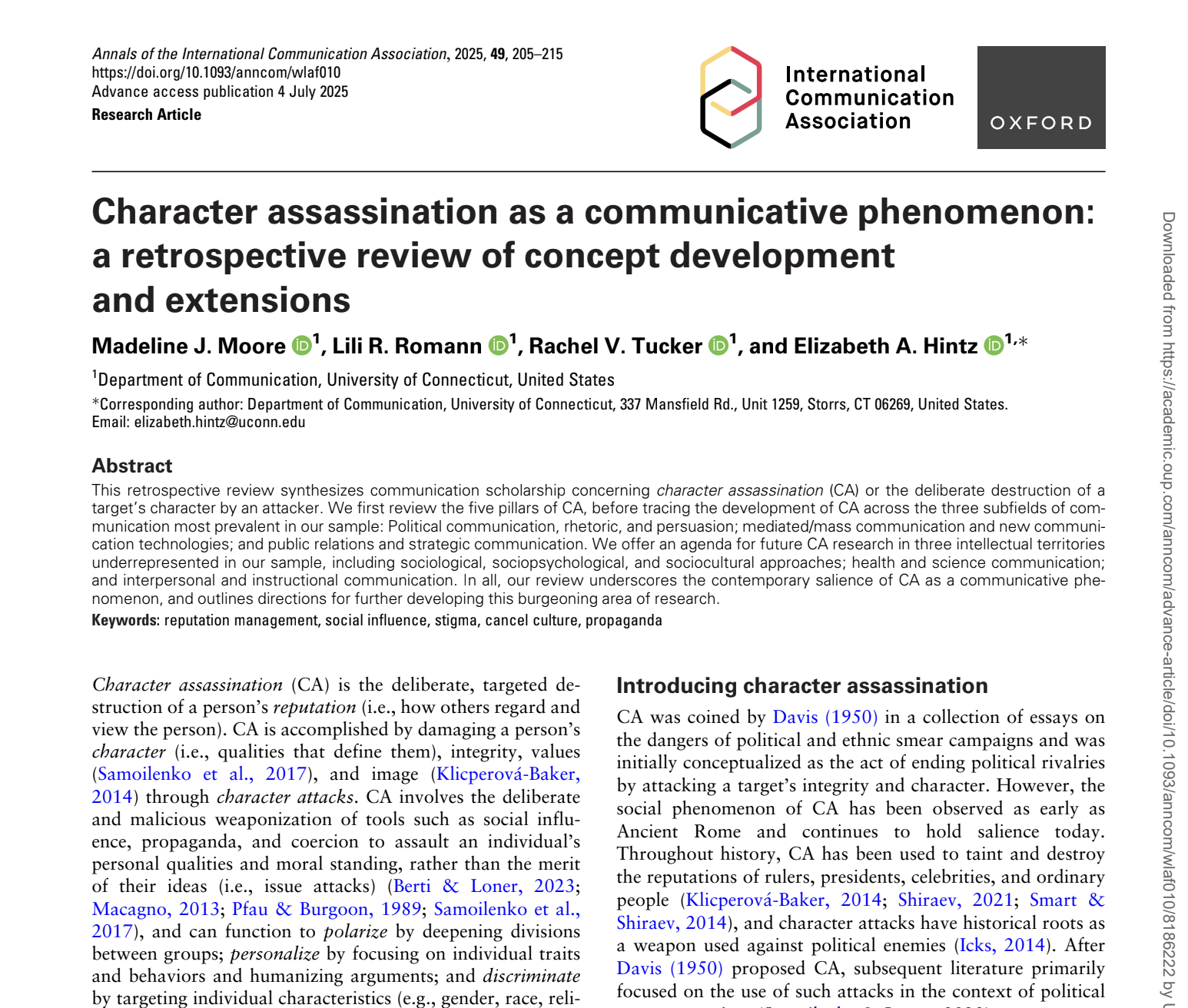
**Moore, M. J., Romann, L. R., Tucker, R. V., & Hintz, E. A. (2025). Character assassination as a communicative phenomenon: A retrospective review of concept development and extensions. Annals of the International Communication Association, 49(3), 205–215. https://doi.org/10.1093/anncom/wlaf010
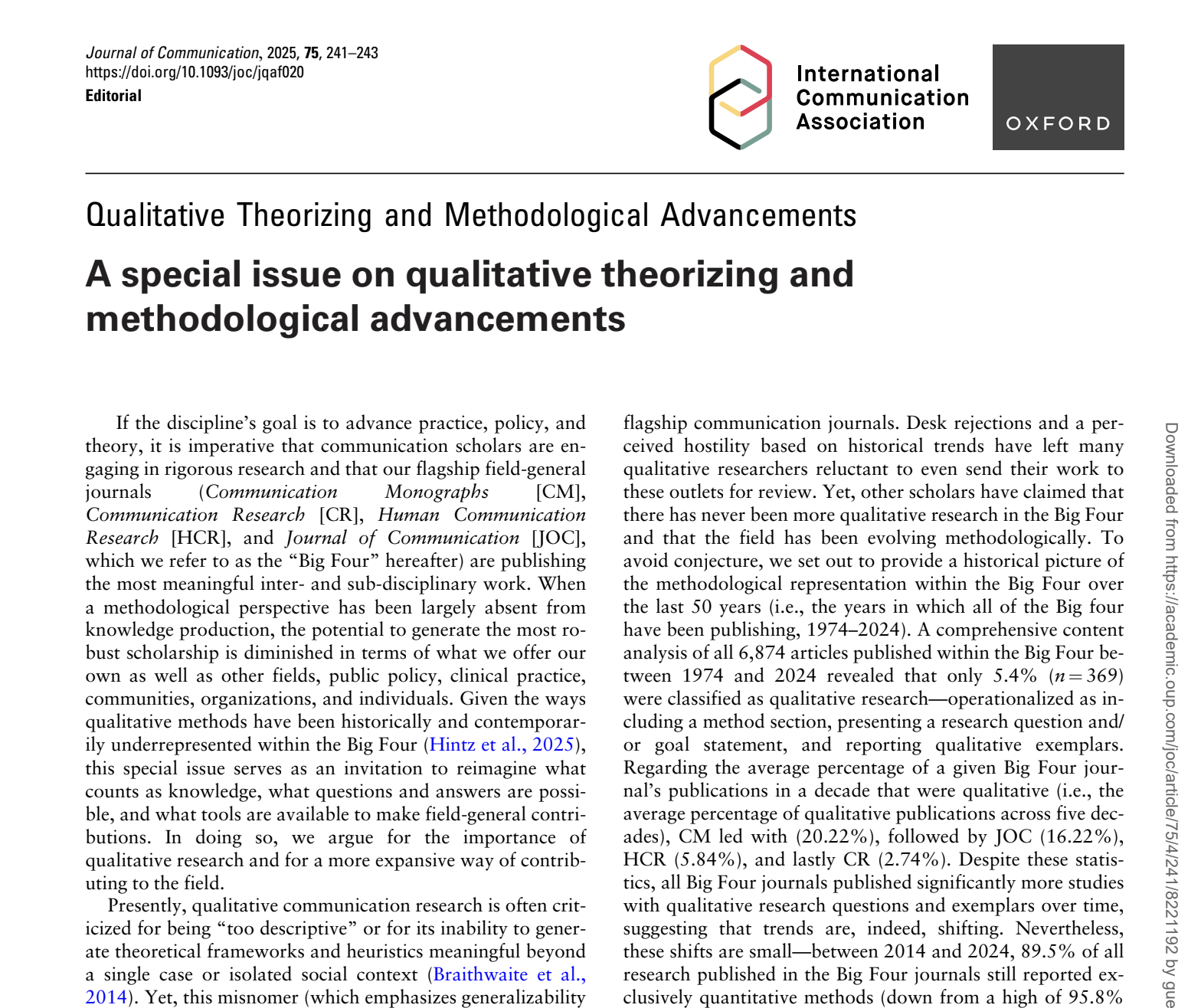
Scharp, K. M., Hintz, E. A., & Vera Zambrano, S. (2025). A special issue on qualitative theorizing and methodological advancements. Journal of Communication, 75(4), 241–243. https://doi.org/10.1093/joc/jqaf020
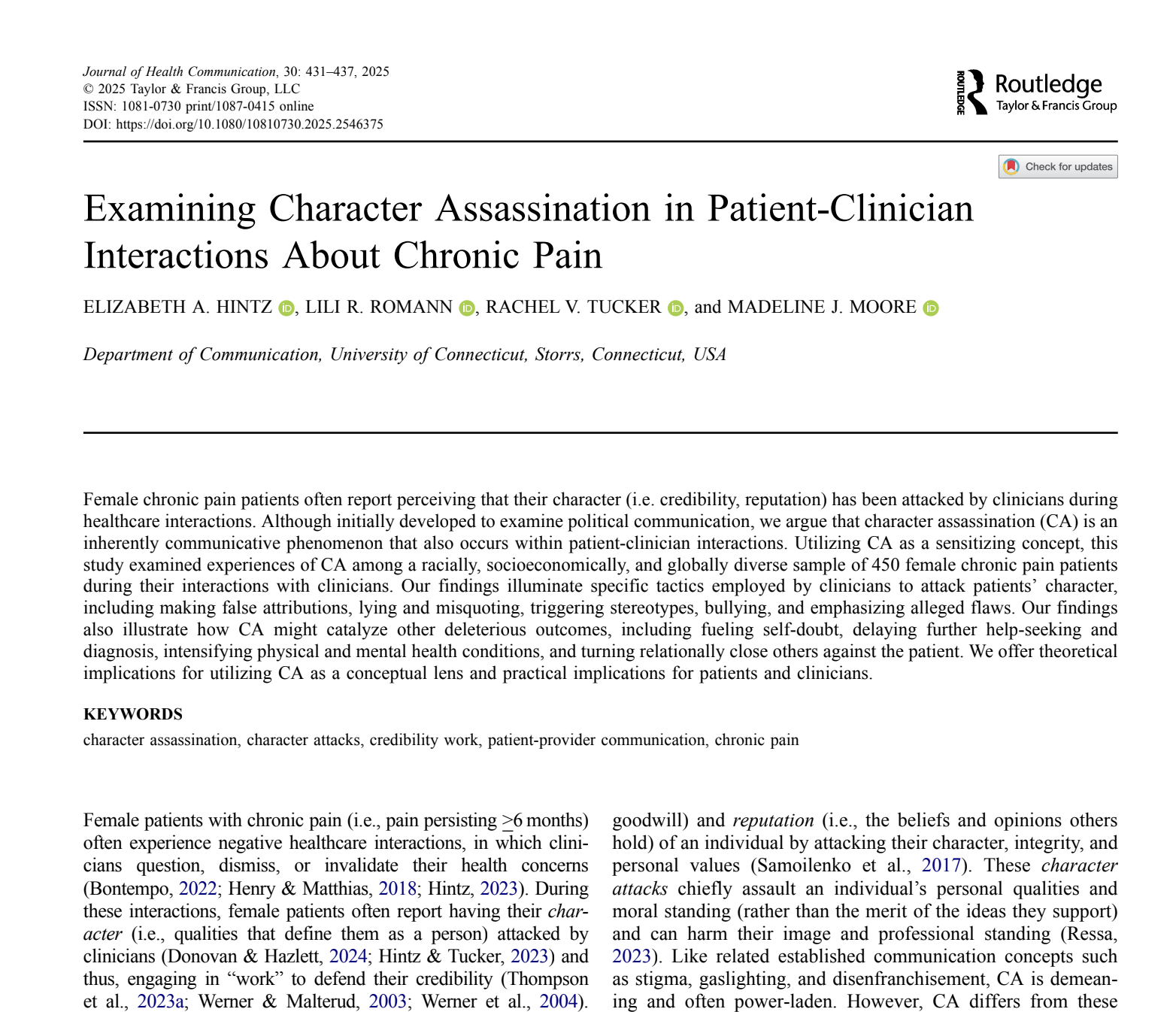
Hintz, E. A., Romann L. R., Tucker, R. V., & **Moore, M. J. (2025). Character assassination in patient-clinician interactions about female patients’ chronic pain. Journal of Health Communication, 30(10-12), 431–437. https://doi.org/10.1080/10810730.2025.2546375
Tucker, R. V., Hintz, E. A., Denes, A., & Gunning, J. N. (2025). Disclosing sexual dysfunction in new romantic relationships: An experimental test of five strategies from the revelation risk model. Health Communication, 40(10), 1884–1895. https://doi.org/10.1080/10410236.2024.2427957
*Romann, L. R. & Hintz, E. A. (2025). Teaching oppositional resistance to the weaponization of artificial intelligence in acts of gendered violence. Feminist Pedagogy, 6(3), 1–6. https://digitalcommons.calpoly.edu/feministpedagogy/vol6/iss3/1
2024
Wolfe, B. H., Gunning, J. N., Boateng, S., Hintz, E. A., & Cardwell, M. E. (2024). Disenfranchising talk mediates the relationship between social determinants of health and wellbeing outcomes for women of color patients with autoimmune disease. Journal of Health Communication, 29(8), 548–555. https://doi.org/10.1080/10810730.2024.2384888 *OPEN ACCESS*
Wilson, S. R., DeBeck, D., Betts, T., Boumis, J., Kuang, K., Hintz, E. A., *Whipple, T., Buzzanell, P. M. (2024). Constructing optimism as anticipatory resilience: Enacting resilience processes following pandemic-related job loss predicts optimism of lessons learned. International Journal of Communication, 18(2024), 4533–4553. https://ijoc.org/index.php/ijoc/article/view/21920
Tucker, R. V., Gunning, J. N., Hintz, E. A., & Denes, A. (2024). A critical quantitative approach to examining intersectionality: Interrogating race and class in the context of female chronic pain. Communication Studies, 75(4), 425–444. https://doi.org/10.1080/10510974.2024.2344404
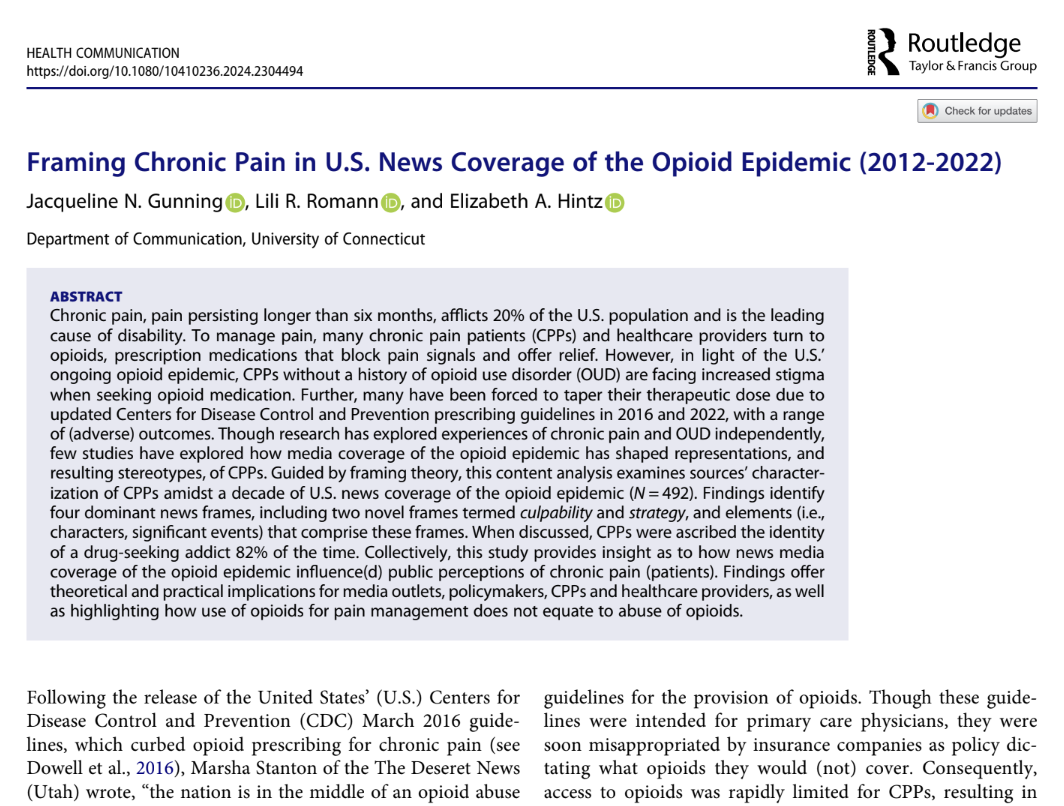
Gunning, J. N., *Romann, L. R., & Hintz, E. A. (2024). Framing chronic pain in U.S. news coverage of the opioid epidemic (2012-2022). Health Communication, 39(13), 3122–3133. https://www.doi.org/10.1080/10410236.2024.2304494
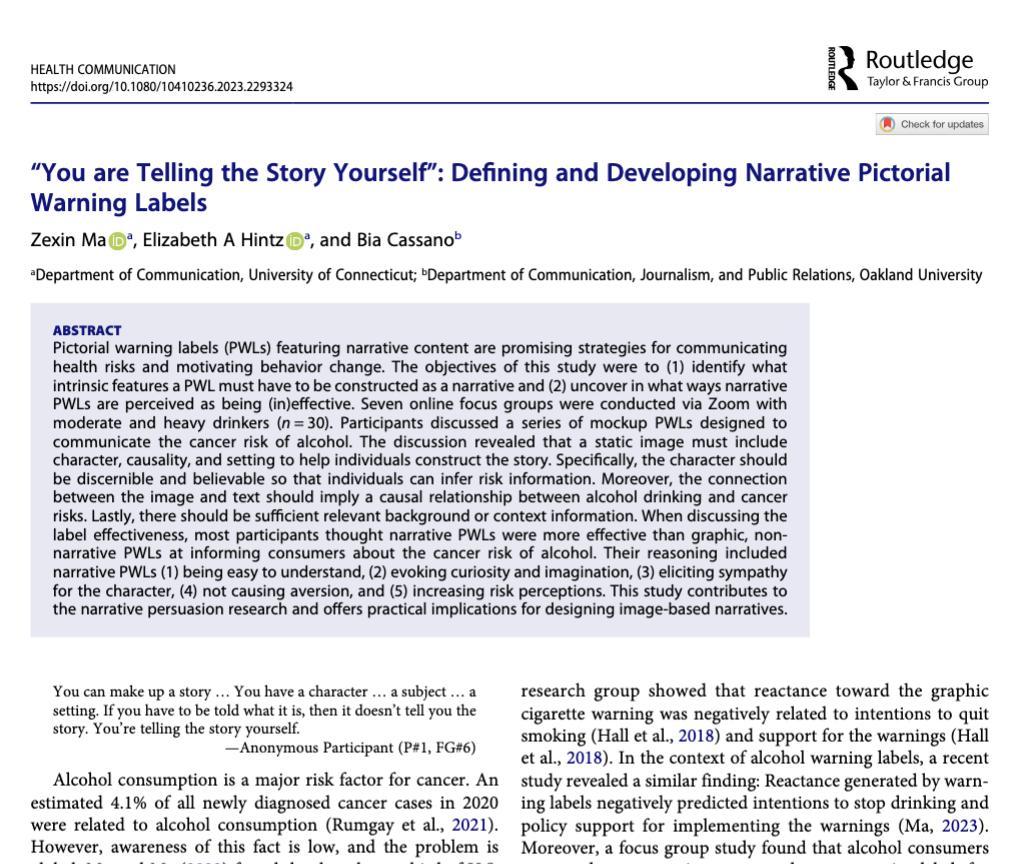
Ma, Z., Hintz, E. A., & **Cassano, B. (2024). “You are telling the story yourself”: Defining and developing narrative pictorial warning labels. Health Communication, 39(12), 2920–2930. https://doi.org/10.1080/10410236.2023.2293324
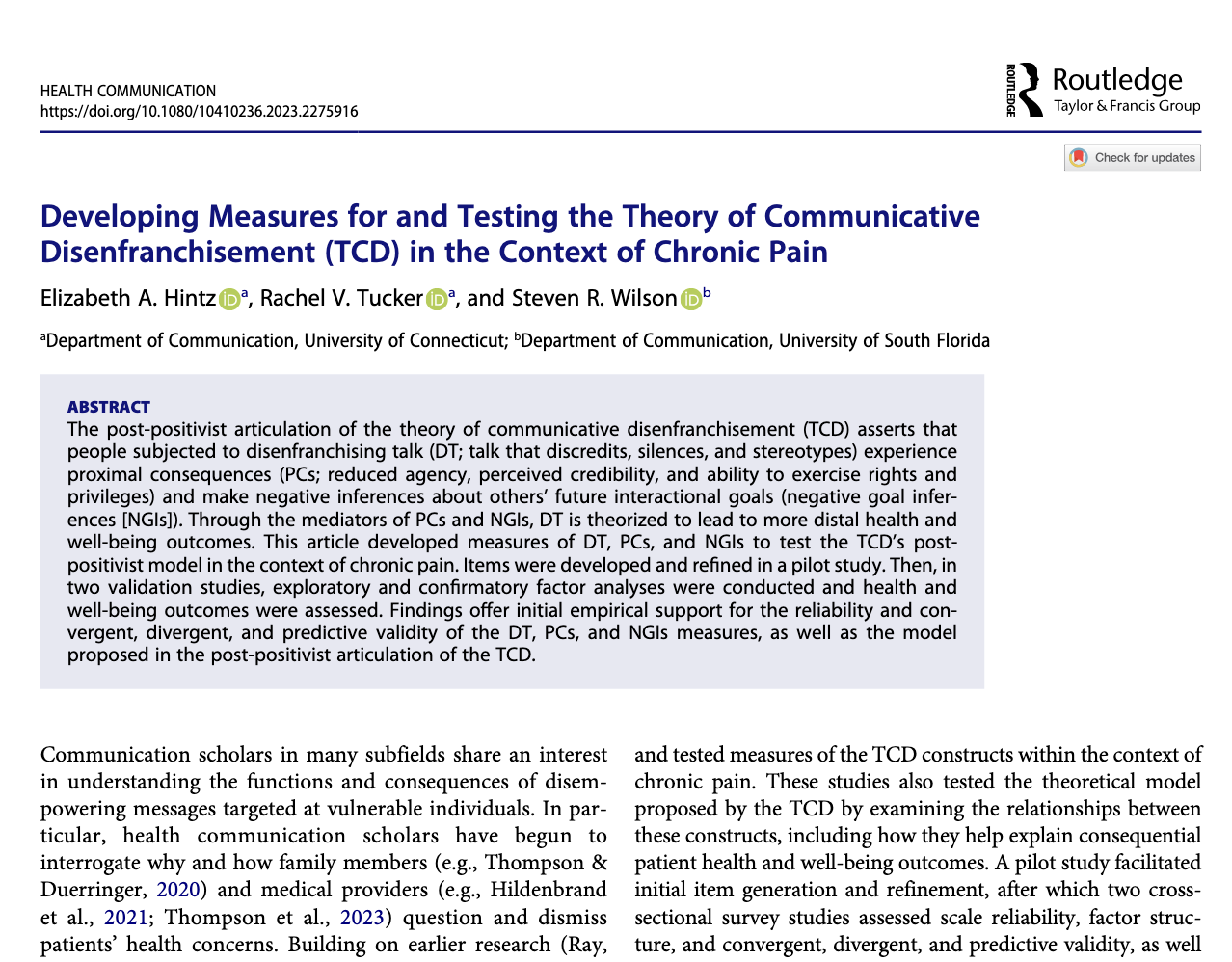
Hintz, E. A., *Tucker, R. V. & Wilson, S. R. (2024). Developing measures for and testing the theory of communicative disenfranchisement (TCD) in the context of chronic pain. Health Communication, 39(12), 2510–2523. http://dx.doi.org/10.1080/10410236.2023.2275916
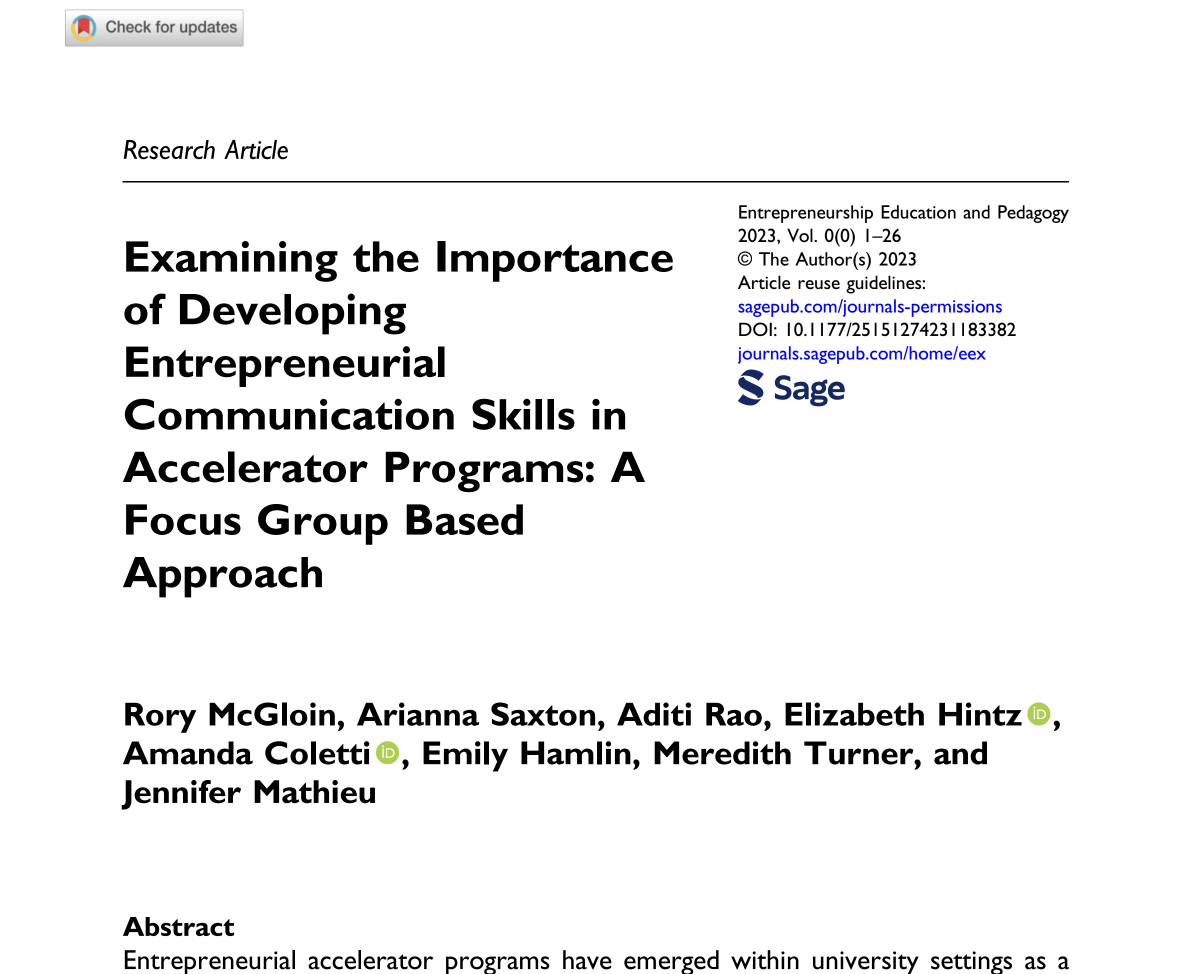
McGloin, R., **Saxton, A., Rao, A., Hintz, E. A., Coletti, A., Hamlin, E., Turner, M., & Mathieu, J. (2024). Communication at the center? A qualitative investigation into the value of business communication training and development within entrepreneurial acceleration centers. Entrepreneurship Education and Pedagogy, 7(4), 468–493. https://doi.org/10.1177/25151274231183382
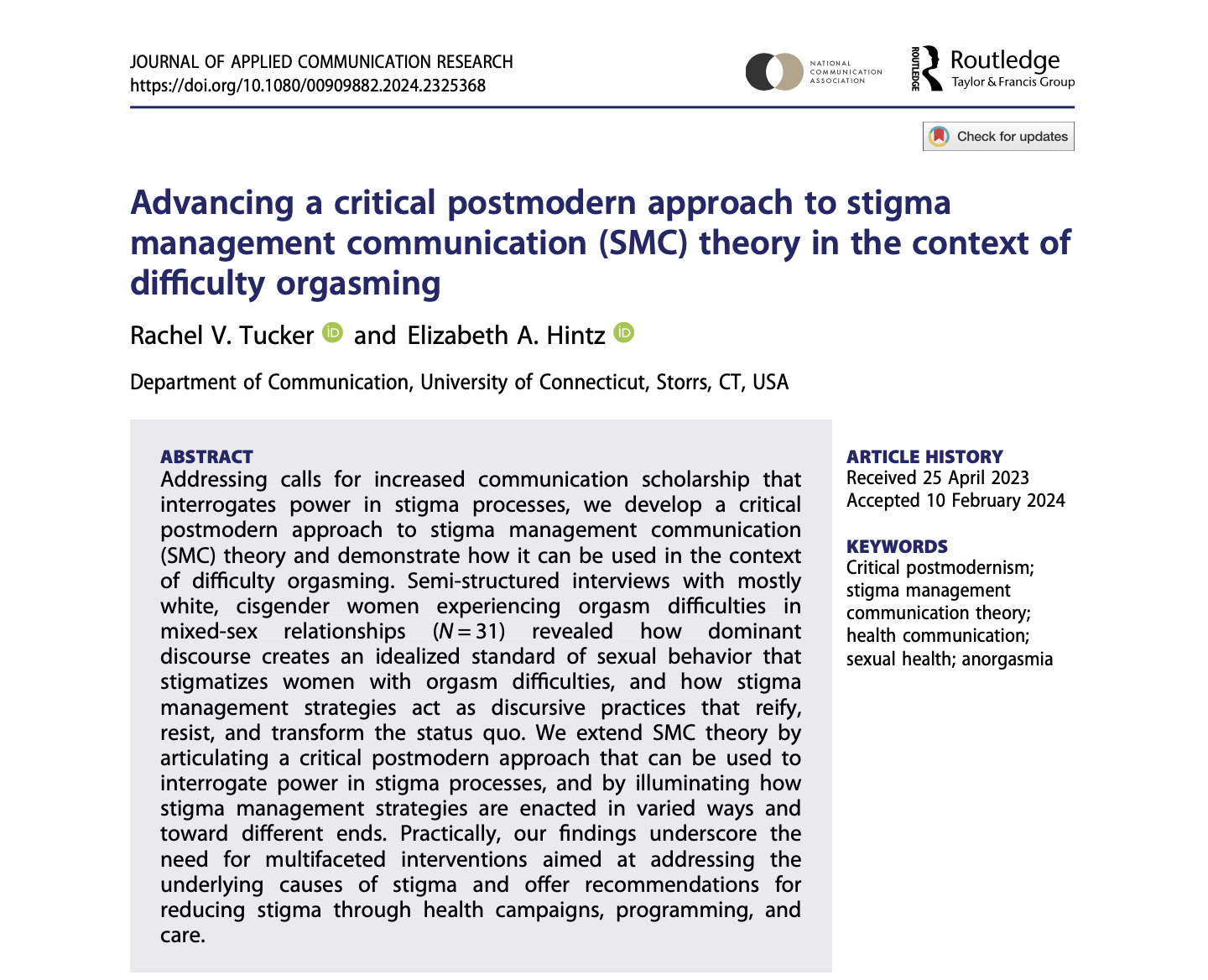
*Tucker, R. V., & Hintz, E. A. (2024). Advancing a critical postmodern approach to stigma management communication (SMC) theory in the context of difficulty orgasming. Journal of Applied Communication Research, 52(3), 401–420. https://doi.org/10.1080/00909882.2024.2325368
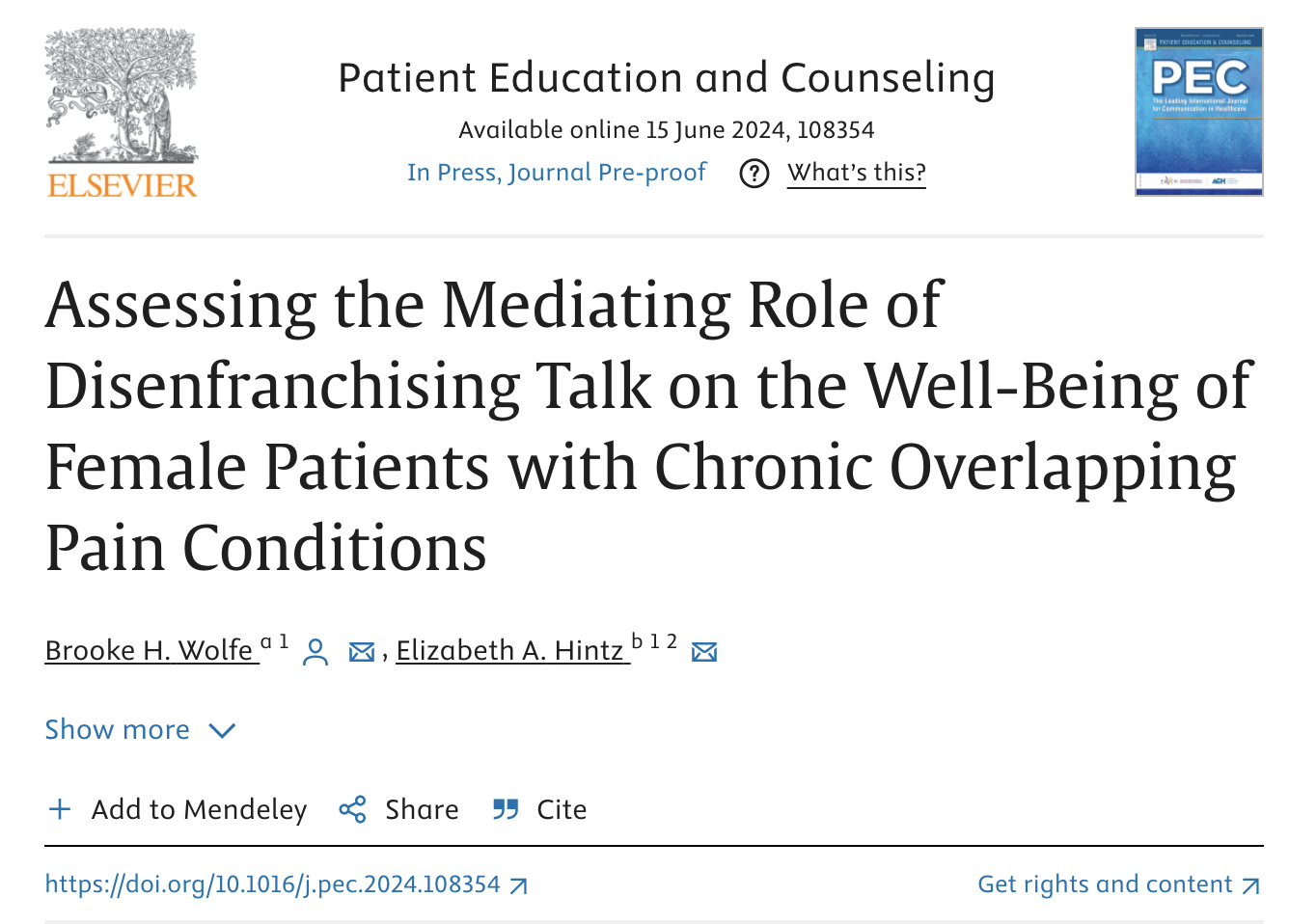
Wolfe, B. H. & Hintz, E. A. (2024). Assessing the mediating role of disenfranchising talk on the well-being of female patients with chronic overlapping pain conditions. Patient Education and Counseling, 127, 108354. https://doi.org/10.1016/j.pec.2024.108354
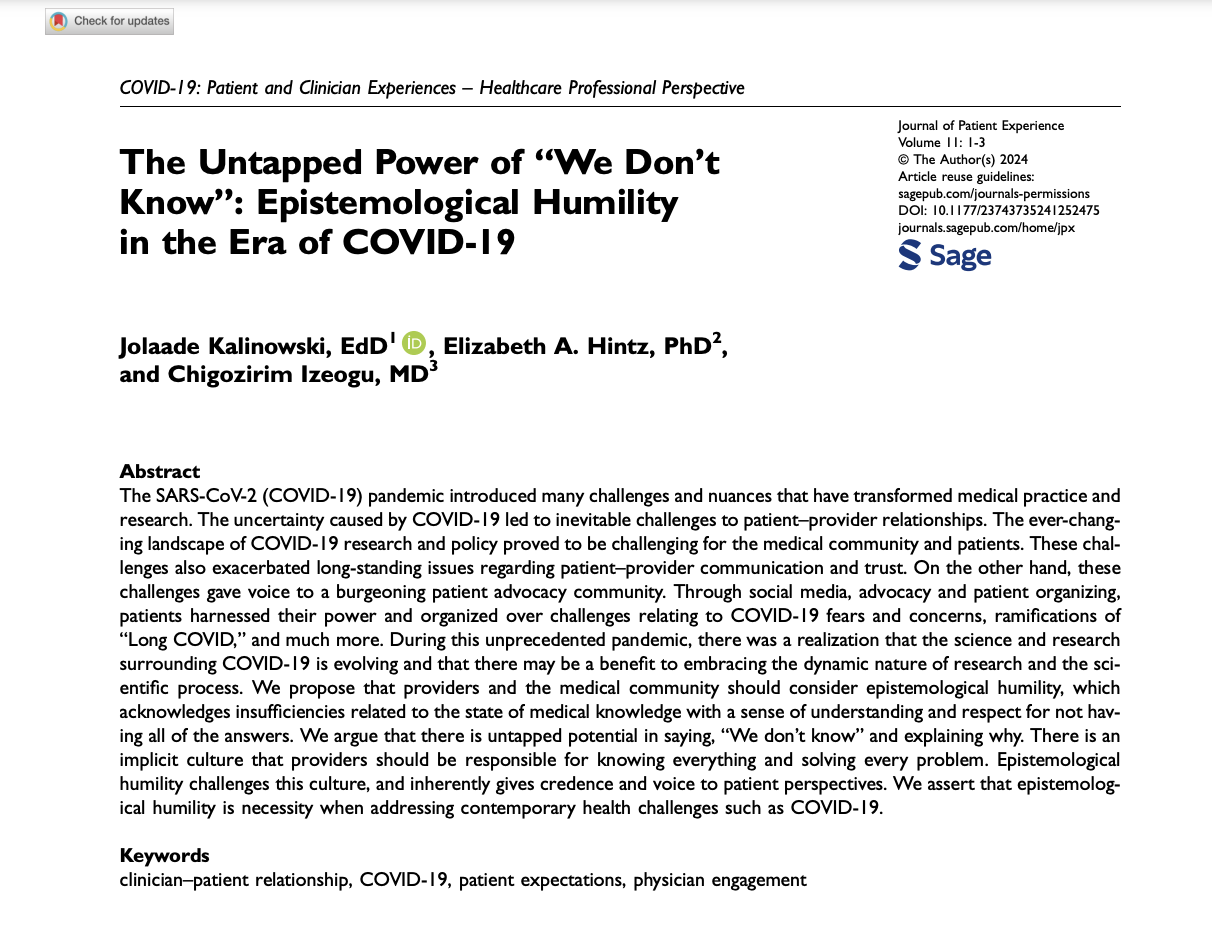
Kalinowski, J., Hintz, E. A., & Izeogu, C. (2024). The untapped power of "We don't know": Incorporating epistemological humility in the era of COVID-19. Journal of Patient Experience, 11(1), 1–3. https://doi.org/10.1177/23743735241252475 *OPEN ACCESS*
Hintz, E. A. & Suk, J. (2024). Communication work about chronic pain: A mixed methods application and extension of the integrative theory of communication work. Communication Monographs, 91(2), 325–349. https://doi.org/10.1080/03637751.2023.2290188
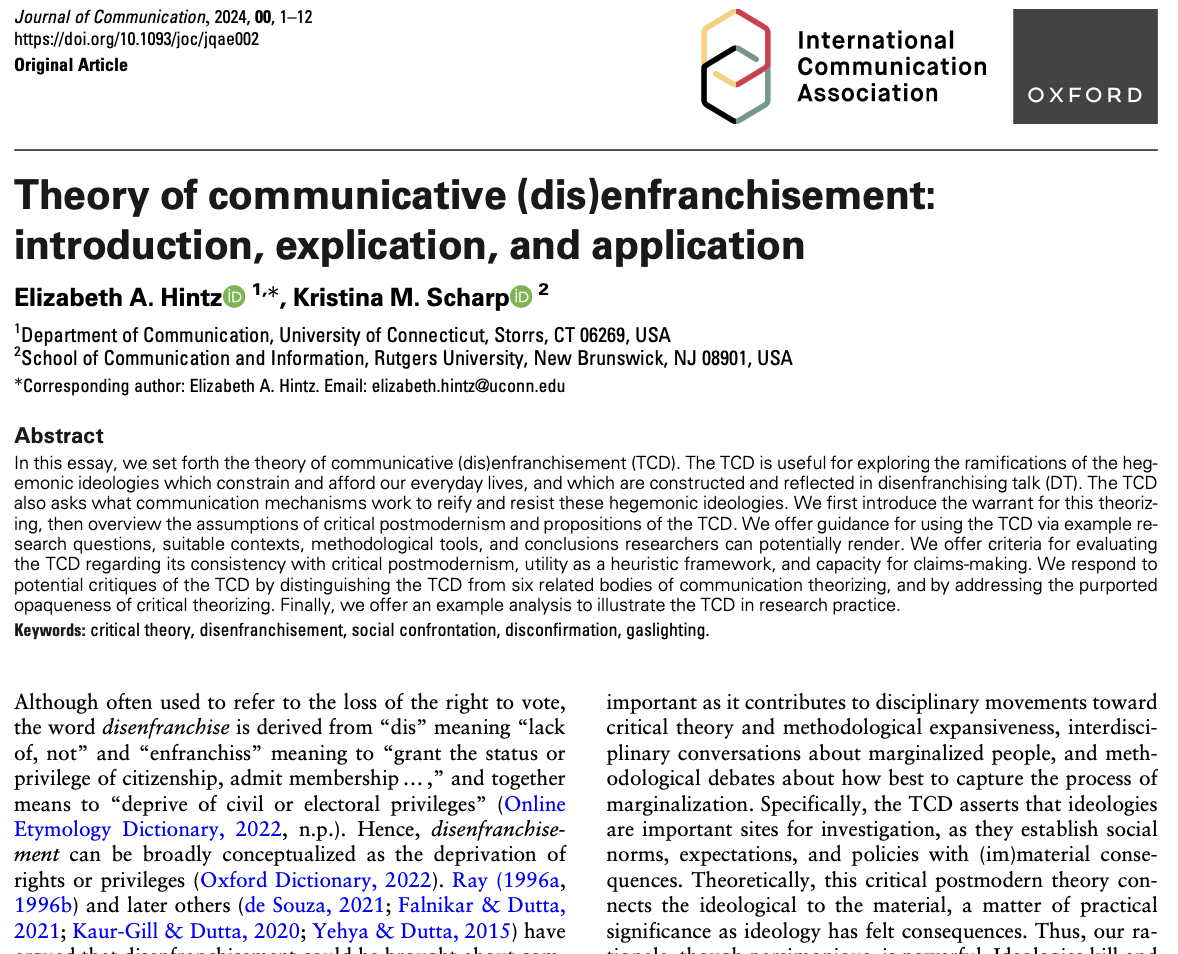
Hintz, E. A. & Scharp, K. M. (2024). Theory of communicative (dis)enfranchisement: Introduction, explication, and application. Journal of Communication, 74(2), 89–100. https://doi.org/10.1093/joc/jqae002 OPEN ACCESS
2023
Hintz, E. A. (2023). Improving communication between women with chronic genital pain and their romantic partners: Insights and recommendations for practice. The Journal of Sexual Medicine, 20(6), 918–920. https://doi.org/10.1093/jsxmed/qdad050
Dorrance-Hall, E., Wilson, S. R., Gettings, P. E., Hintz, E. A., **Vidal, A. (2023). Turning points, trajectories, and accounts of military partners’ post-deployment adjustment concerns. Journal of Social and Personal Relationships, 40(11), 3679–3702. https://doi.org/10.1177/02654075231187700
Hintz, E. A. & Scharp, K. M. (2023). “I hate all the children, especially mine”: Applying relational dialectics theory to examine the experiences of formerly childfree regretful parents. Journal of Social and Personal Relationships, 40(11) 3781–3799. https://doi.org/10.1177/02654075231194363
Hintz, E. A. (2023). Promoting a social justice sensibility in qualitative communication research practice. Qualitative Research Reports in Communication, 24(1), 41–51. https://doi.org/10.1080/17459435.2022.2051594
Hintz, E. A. & Applequist, J. (2023). E-Sisters and the case of the Essure coil: Power, representation, and voice in women’s public docket accounts to the FDA of medical device adverse events. Journal of Applied Communication Research, 51(5), 500–518. https://doi.org/10.1080/00909882.2023.2179417
Hintz, E. A., & *Tucker, R. V. (2023). Perceptions of the childfree. In M. Powers (Ed.), Oxford research encyclopedia of communication. Oxford. https://doi.org/10.1093/acrefore/9780190228613.013.1449
Hintz, E. A. (2023). “It’s all in your head”: A meta-synthesis of qualitative research about disenfranchising talk experienced by female patients with chronic overlapping pain conditions. Health Communication, 38(11), 2501–2515. https://doi.org/10.1080/10410236.2022.2081046
Kuang, K., Wilson, S. R., *Betts, T., Boumis, J., Hintz, E. A., *DeBeck, D., Buzzanell, P. M. (2023). A longitudinal analysis of involuntary job loss and communication resilience processes during the COVID-19 pandemic. Journal of Communication, 73(4), 382–397. https://doi.org/10.1093/joc/jqad004
Dean, M., Hintz, E. A., Baker, J. T., Reblin, M., Quinn, G. P., Haskins, C., & Vadaparampil, S. T. (2023). Shared decision-making experiences of couples with inherited cancer risk regarding family building. Journal of Health Communication, 24(5), 292–301. https://doi.org/10.1080/10810730.2023.2202630
+Hintz, E. A. & +*Tucker, R. V. (2023). Contesting illness: Communicative (dis)enfranchisement in patient-provider conversations about chronic overlapping pain conditions. Human Communication Research, 49(2), 170–181. https://doi.org/10.1093/hcr/hqad004
+Authors are listed in alphabetical order but contributed equally to this manuscript.
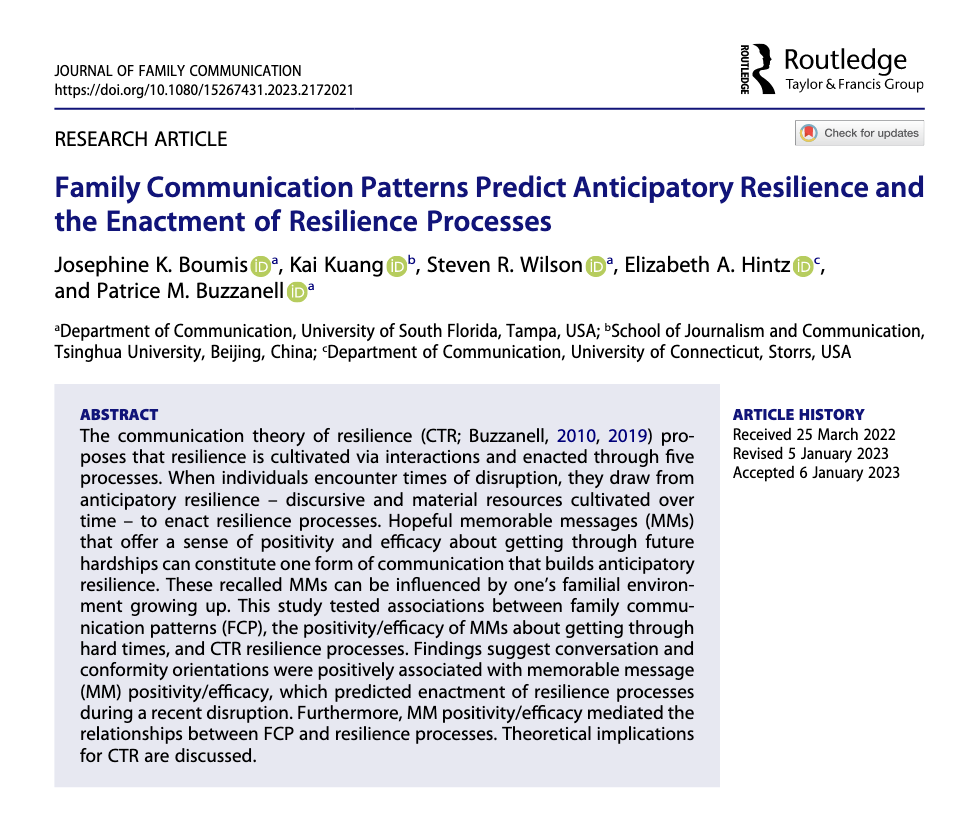
Boumis, J., Kuang, K. Wilson, S. R., Hintz, E. A., & Buzzanell, P. M. (2023). Family communication patterns predict anticipatory resilience and the enactment of resilience processes. Journal of Family Communication, 23(1), 22–40. https://doi.org/10.1080/15267431.2023.2172021
Hintz, E. A., *Betts, T., & Buzzanell, P. M. (2023). Healthcare workers without PPE: Material conditions as multidimensional cascading triggers for resilience processes. Health Communication, 38(2), 371–380. https://doi.org/10.1080/10410236.2021.1953727
2022
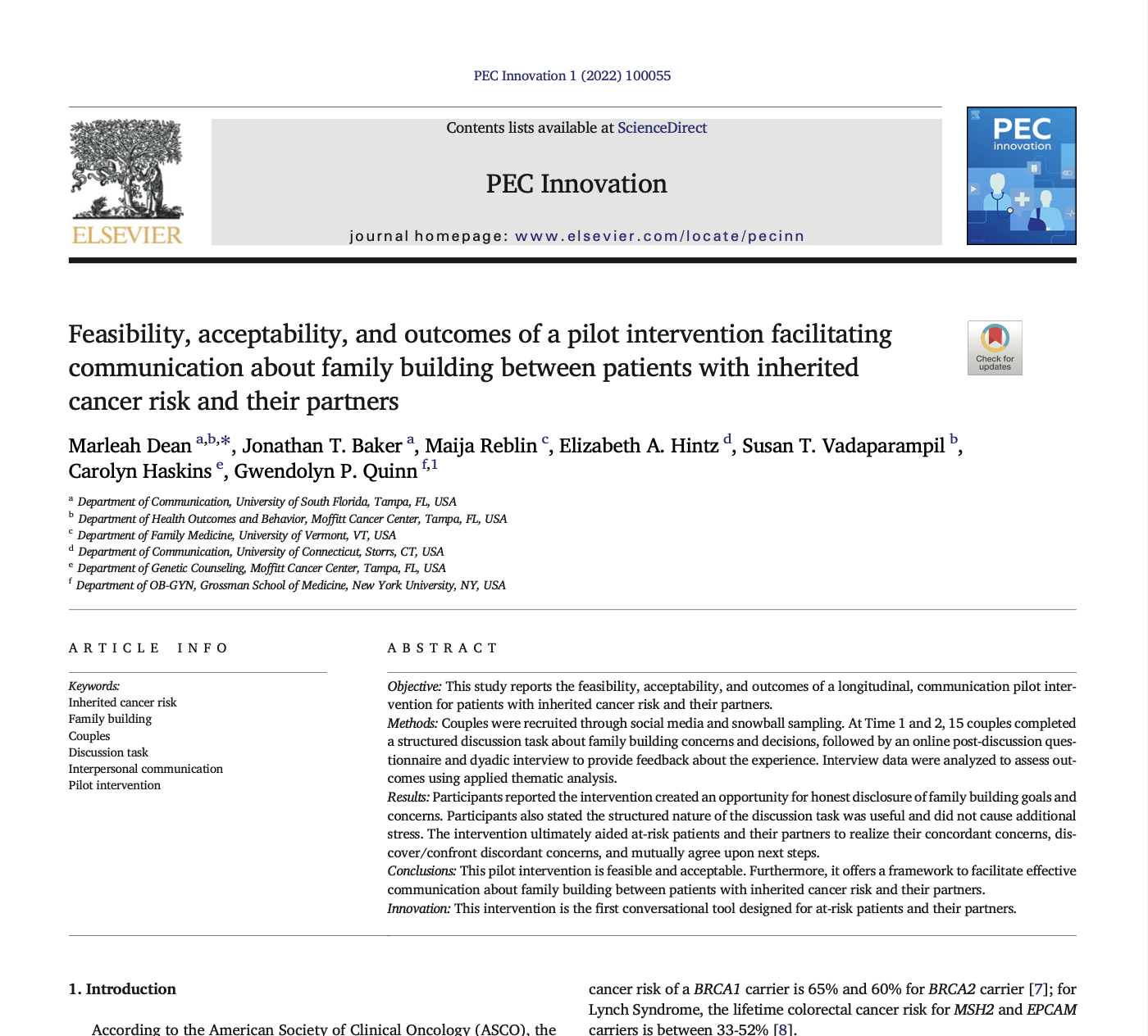
Dean, M., *Baker, J. T., Reblin, M., Hintz, E. A., Quinn, G. P., Vadaparampil, S. T. (2022). Feasibility, acceptability, and outcomes of a pilot intervention facilitating communication about family building among unaffected couples at risk for inherited cancer. Patient Education and Counseling (PEC) – Innovation, 1(1), 100055. https://doi.org/10.1016/j.pecinn.2022.100055
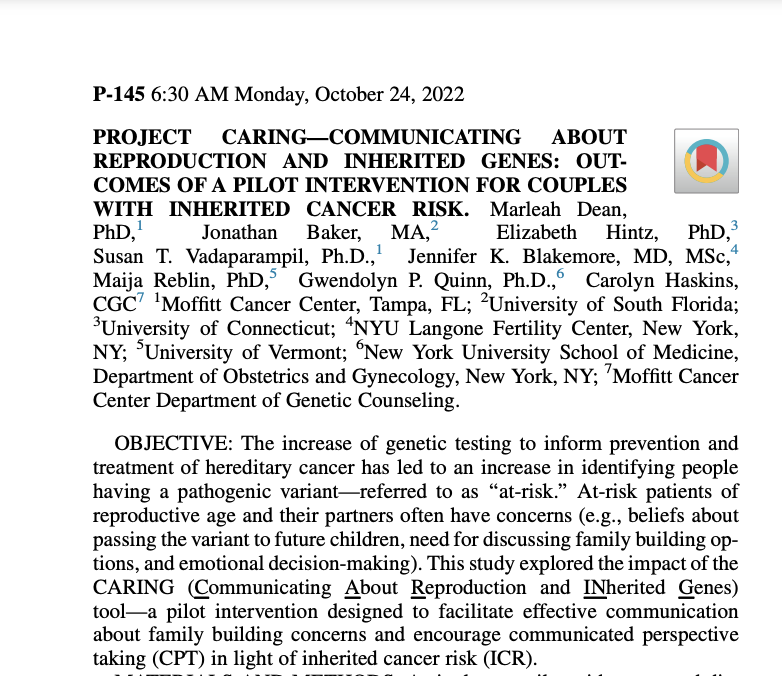
Dean, M., Baker, J. T., Hintz, E. A., Vadaparampil, S. T., Blakemore, J. K., Reblin, M., Quinn, G. P., Haskins, C. (2022). Project CARING—Communicating about reproduction and inherited genes: Outcomes of a pilot intervention for couples with inherited cancer risk. Fertility and Sterility, 118(4), SE171. https://doi.org/10.1016/j.fertnstert.2022.08.491
Hintz, E. A. & Betts, T. (2022). Reddit in communication research: Current status, future directions, and best practices. Annals of the International Communication Association, 46(2), 116–133. http://dx.doi.org/10.1080/23808985.2022.2064325
Hintz, E. A. (2022). Childfree sterilization: A normative rhetorical theory analysis of paradoxical dilemmas encountered by childfree patients and their providers. Rhetoric of Health & Medicine, 5(3), 280-307. https://doi.org/10.5744/rhm.2022.50014
Betts, T., Hintz, E. A., & Buzzanell, P. M. (2022). Emplotting anticipatory resilience through antenarrative: An extension of the communication theory of resilience. Communication Monographs, 89(2), 211-234. https://doi.org/10.1080/03637751.2021.1971272
Thompson, C. M., Hintz, E. A., & Duerringer, C. M. (2022). Setting the agenda: Beyond discourse dependence and a dependence on discourse. Journal of Family Communication, 22(2), 175-184. All authors contributed equally to this manuscript. https://doi.org/10.1080/15267431.2022.2041997
Scott, K. D., Hintz, E. A., & Harris, T. M. (2022). “Having pain is normal”: How talk about chronic pelvic and genital pain reflects messages from menarche. Health Communication, 37(3), 296-306. https://doi.org/10.1080/10410236.2020.1837464
2021
Applequist, J., Hintz, E. A., *Quichocho, D., *Chesser, S., *Price, D., *Sturgess, S., *Giardino, M., & Young, H. N. (2021). Information versus influence: An analysis of educational, relational, and identity rewards present in direct-to-consumer prescription drug advertising. Journal of the American Pharmacists Association, 61(6), 795-803. https://doi.org/10.1016/j.japh.2021.06.018
Hintz, E. A. & Wilson, S. R. (2021). Theorizing disenfranchisement as a communicative process. Review of Communication, 12(3), 241-251. https://doi.org/10.1080/15358593.2021.1965194
Wilson, S. R., & Kuang, K., Hintz, E. A., & Buzzanell, P. M. (2021). Developing and validating the communication resilience processes (CRP) scale. Journal of Communication, 71(3), 478-513. https://doi.org/10.1093/joc/jqab013
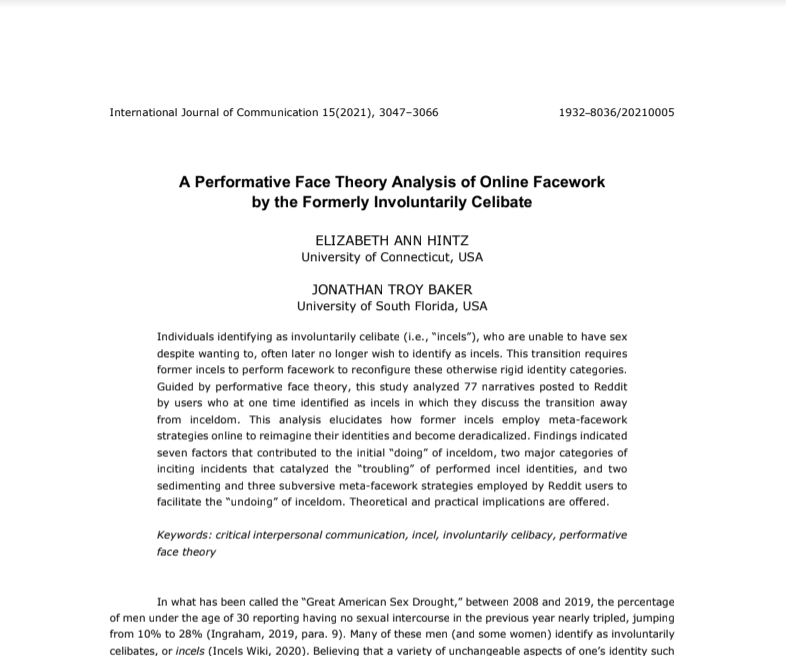
Hintz, E. A. & Baker, J. T. (2021). A performative face theory analysis of online facework by the formerly involuntarily celibate. International Journal of Communication, 15(1), 3047-3066. https://ijoc.org/index.php/ijoc/article/view/16847/3487
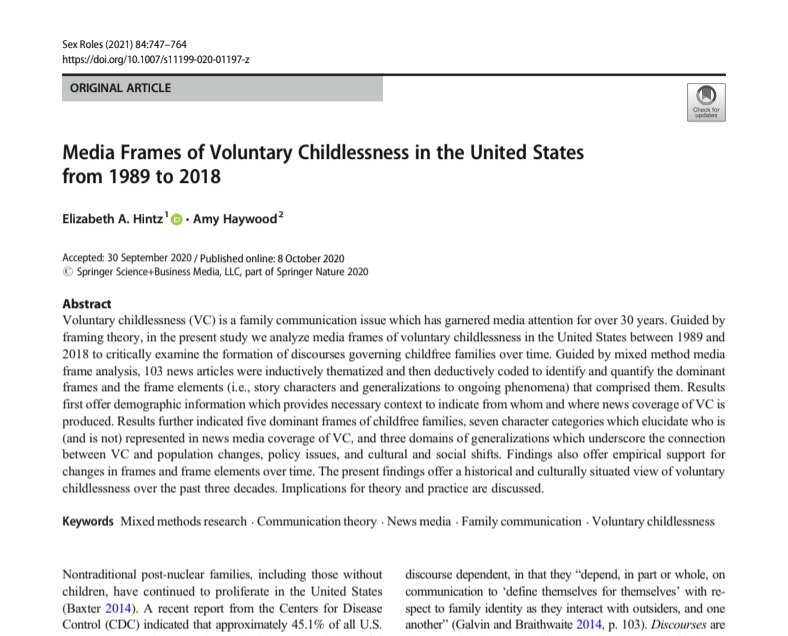
Hintz, E. A. & Haywood, A. (2021). Media frames of voluntary childlessness in the United States between 1989 and 2018. Sex Roles, 84(11), 747-764. https://doi.org/10.1007/s11199-020-01197-z
Hintz, E. A. & Scott, K. D. (2021). Communication work about chronic unexplained pain. Health Communication, 36(5), 659-662. https://doi.org/10.1080/10410236.2020.1731915
Wilson, S. R., Hintz, E. A., MacDermid Wadsworth, S., Topp, D., Southwell, K. H. & Spoont, M. (2021). Female U.S. military veterans’ (non)disclosure of mental health issues with family and friends: Privacy rules and boundary management. Health Communication, 36(4), 412-423.
https://doi.org/10.1080/10410236.2019.1693128
2020
Hintz, E. A. (2020). Pain communication: An agenda for communication researchers. Annals of the International Communication Association, 44(4), 401-421. https://doi.org/10.1080/23808985.2020.1843368
Hintz, E. A., & Huber, A. A. (2020). Verbs, visuals, & vignettes: Incorporating images into the impromptu speaking exercise. Communication Teacher, 34(3), 224-230. https://doi.org/10.1080/17404622.2019.1653488
Hintz, E. A. & Brown, C. L. (2020). Childfree and "bingoed": A relational dialectics theory analysis of meaning creation in online narratives about voluntary childlessness. Communication Monographs, 87(2), 244-266. https://doi.org/10.1080/03637751.2019.1697891
Hintz, E. A., & Dean, M. (2020). Best practices for returning research findings to participants: Methodological and ethical considerations for communication researchers. Communication Methods and Measures, 14(1), 38-54. https://doi.org/10.1080/19312458.2019.1650165
2019
Hintz, E. A. (2019). The vulvar vernacular: Dilemmas experienced and strategies recommended by women with chronic genital pain. Health Communication, 34(14), 1721-1730. https://doi.org/10.1080/10410236.2018.1517709
Inderstrodt-Stephens, J., Perrault, E. K., Hintz, E. A., & Hildebrand, G. (2019). Addressing health disparities in America: An analysis of Community Health Improvement Plans across the United States. Nursing Research, 68(5), 405-412. https://doi.org/10.1097/NNR.0000000000000364
Hintz, E. A. (2019). Disrupting sexual norms: An application of the critical interpersonal and family communication (CIFC) framework in the context of vulvodynia. Journal of Family Communication, 19(2), 110-125. https://doi.org/10.1080/15267431.2019.1580196
Hintz, E. A. & Brown, C. L. (2019). Childfree by choice: Stigma in medical consultations for voluntary sterilization. Women’s Reproductive Health, 6(1), 62-75. https://doi.org/10.1080/23293691.2018.1556427
Hintz, E. A., Hirceaga, A. M., & Perrault, E. K. (2019). Factors influencing patients’ choice of a physiotherapist: A study within the Swiss insurance premium-funded system. European Journal of Physiotherapy, 21(4), 204-209. https://doi.org/10.1080/21679169.2018.1515981
2018
Perrault, E. K., Inderstrodt-Stephens, J., & Hintz, E. A. (2018). Tracking success – outputs versus outcomes: A comparison of accredited and non-accredited public health agencies’ Community Health Improvement Plan objectives. Journal of Community Health, 43(3), 570–577.
http://doi.org/10.1007/s10900-017-0454-0